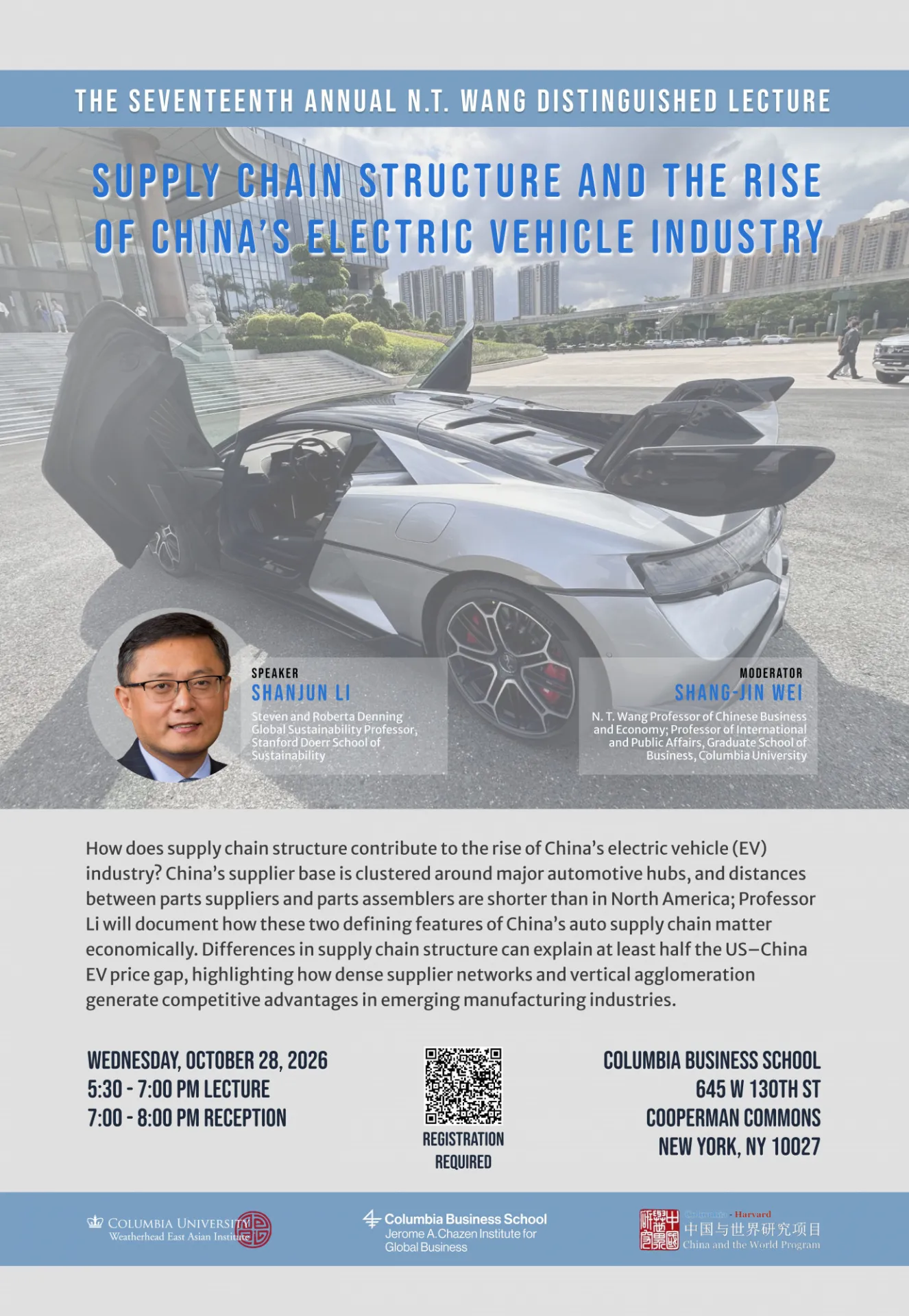
The Weatherhead East Asian Institute and the Jerome A. Chazen Institute for Global Business are pleased to announce the 17th Annual N. T. Wang Distinguished Lecture: “Supply Chain Structure and the Rise of China’s Electric Vehicle Industry,” featuring:
Shanjun Li, Steven and Roberta Denning Global Sustainability Professor in the Stanford Doerr School of Sustainability and a Senior Fellow at the Freeman Spogli Institute for International Studies, the Stanford Institute for Economic Policy Research, and the Precourt Institute for Energy
Moderated by:
Shang-Jin Wei, N. T. Wang Professor of Chinese Business and Economy; Professor of International and Public Affairs, Graduate School of Business, Columbia University
This talk examines how supply chain structure contributed to the rise of China’s electric vehicle (EV) industry. Combining the universe of buyer–seller matched transactions in upstream auto parts production with detailed downstream vehicle sales data, we document two defining features of China’s auto supply chain: market thickness and geographic co-location.
China’s supplier base is exceptionally dense and spatially clustered around major automotive hubs, and supplier–assembler distances are substantially shorter than in North America across many component categories. These features matter economically: thicker upstream markets reduce input prices through stronger competition, better supplier selection, and improved matching, while proximity between suppliers and assemblers raises matching probability, increases transaction volume, and improves product quality, especially for more customized parts.
To quantify these mechanisms, we develop and estimate a structural model that combines a bargaining model between upstream part suppliers and downstream automakers with differentiated-product Bertrand competition downstream. The model links supplier competition, input prices, and input quality to downstream vehicle pricing and demand. Counterfactual simulations imply that if China had the upstream supply chain structure of the United States, EV prices would increase by about 40 percent and sales would fall by over 70 percent. Overall, differences in supply chain structure can explain at least half of the U.S.–China EV price gap. The results highlight how dense supplier networks and vertical agglomeration can generate major competitive advantages in emerging manufacturing industries.
Speakers' Bios:
Shanjun Li is the Steven and Roberta Denning Global Sustainability Professor and a Senior Fellow at the Freeman Spogli Institute for International Studies, the Stanford Institute for Economic Policy Research, and the Precourt Institute for Energy. His research focuses on environmental and energy economics, urban and transportation economics, empirical industrial organization, and the Chinese economy. His recent work examines pressing sustainability challenges and the rapid rise of clean energy industries in China, exploring their global implications to inform evidence-based policymaking.
A noted scholar of international finance, trade, and the Chinese economy, Dr. Shang-Jin Wei is N.T. Wang Professor of Chinese Business and Economy and Professor of Finance and Economics at Columbia University’s Graduate School of Business and School of International and Public Affairs.
His honors and awards include the 2019 Contemporary Economics Prize; the Sun Yefang Prize for Distinguished Contributions to Economics; and the Zhang Peifang Prize for Contributions to the Economics of Development. Dr. Wei has served at the Asian Development Bank and the International Monetary Fund and consulted for the U.S. Board of Governors of the Federal Reserve System and Deutsche Bank, among other institutions.
Dr. Wei’s research has been published in such leading academic journals as American Economic Review, the Journal of Political Economy, and the Quarterly Journal of Economics. He holds a PhD in economics and an MS in finance from the University of California, Berkeley.
Schedule:
5:30-7:00 pm: Lecture in Cooperman Commons
7:00-8:00 pm: Reception in the Alumni Suite
This event is hosted by the Weatherhead East Asian Institute and the Jerome A. Chazen Institute for Global Business, and cosponsored by the China and the World Program at Columbia University.
Registration: To attend this event in-person, please register HERE (with one unique email address per registrant).