For non-Columbia affiliates, registration is required to access the Morningside campus. After registering you will receive an email with a QR code that must be presented along with a valid government-issued ID (your name must match exactly the name registered for the event) at either the 116th Street & Broadway or 116th Street & Amsterdam gates for entry.
Names will be submitted for QR codes 1-2 days prior to the event. Registrants will receive an email from CU Guest Access with the QR code before or on the day of the event. NOTE: You cannot access campus using the QR code from Eventbrite.
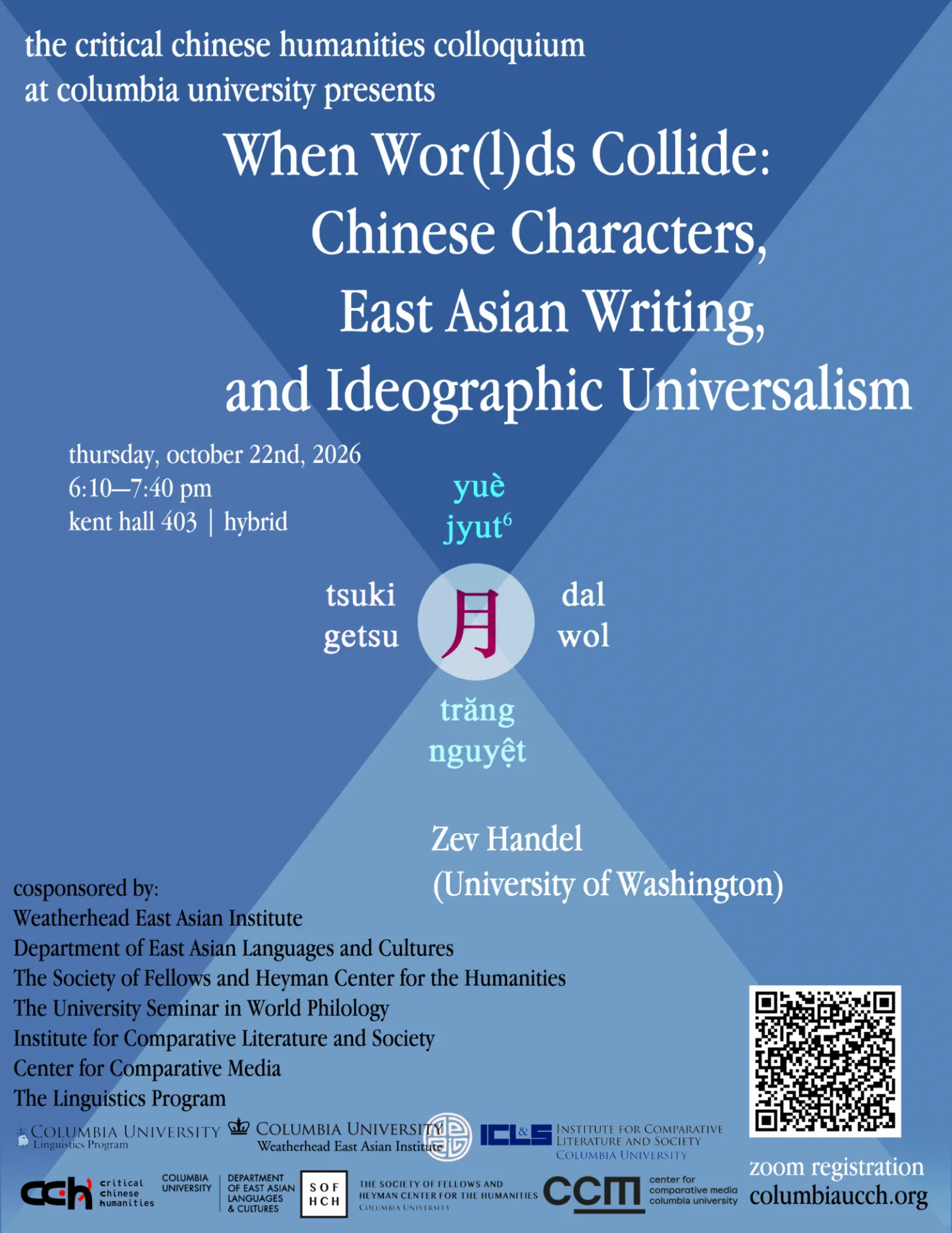
Speaker: Zev Handel, Professor, Asian Languages and Literature, University of Washington
The Chinese character 月 is or has been used to represent words meaning ‘moon’ in Mandarin (yuè), Cantonese (jyut6), Japanese (tsuki), Korean (dal), and Zhuang (ndwen) despite their different pronunciations. It is therefore not surprising that 17th-century European intellectuals believed that unlike alphabetic writing, Chinese characters represented ideas and not words. They thought Chinese characters might serve as a universal tool of communication for speakers of different languages. This view has been debunked as the ideographic myth. It can be easily shown that the origin, development, and contemporary usage of the Chinese script are all inextricably connected to pronunciation of specific spoken words.
This raises an apparent paradox. If Chinese writing represents words just like alphabetic writing does, then why do characters like 月 also appear to transcend language differences and occupy a realm apart from speech?
By examining the typology of the Chinese script, the role of Classical Chinese in pre-modern East Asia, and the mechanisms of adaptation of Chinese characters as they spread across Asia and were adapted to represent other spoken languages (including Japanese, Korean, and Vietnamese), Zev Handel shows that the explanation for the apparent paradox is both mundane and profound. Chinese characters are not embodiments of pure ideas and are not universal in their ability to convey meaning, yet they are infinitely adaptable to represent the words of any spoken language.
Speaker's Bio: Zev Handel received his PhD from UC Berkeley and has taught Chinese linguistics in the Department of Asian Languages and Literature at the University of Washington in Seattle for over 25 years. His research areas include Chinese dialectology, Chinese historical phonology, Sino-Tibetan comparative linguistics, and the development and spread of the Chinese script. He is the author of the scholarly monograph Sinography: The Borrowing and Adaptation of the Chinese Script (Brill, 2019) and of Chinese Characters Across Asia: How the Chinese Script Came to Write Japanese, Korean, and Vietnamese (University of Washington Press, 2025), which is written for a general readership.
This event is hosted by the Critical Chinese Humanities Colloquium and cosponsored by the Department of East Asian Languages and Cultures, The Society of Fellows and Heyman Center for the Humanities, Institute for Comparative Literature and Society, Weatherhead East Asian Institute, The University Seminar in World Philology, Center for Comparative Media, and The Linguistics Program.
Registration: for more information to this hybrid event and registration, please click HERE.