New Documentary Recognizes Cinematic Legacy of Wan-go Weng
I Will Be There After My Wandering furthers the rediscovery begun by Starr Library acquisition of Weng’s films.
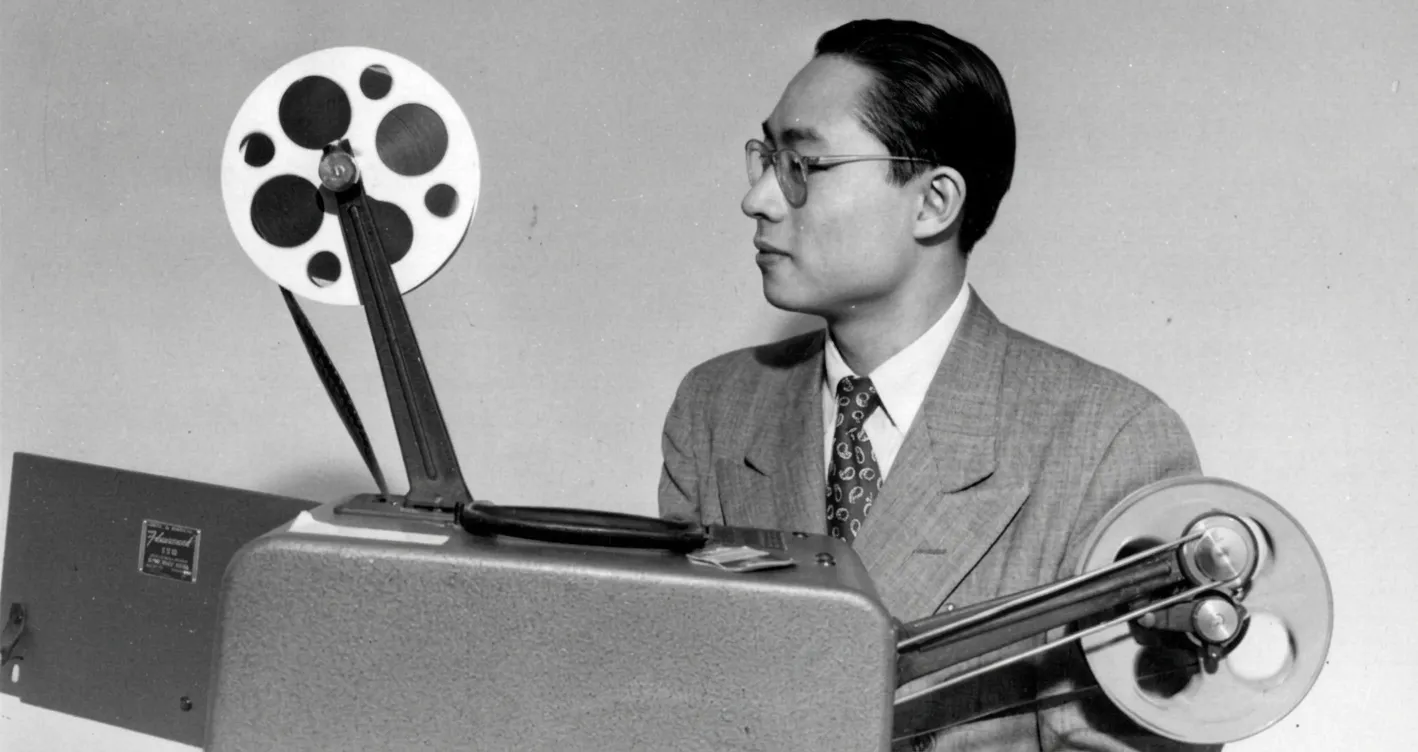
Wan-go Weng in his early 20s. This photograph appears in I Will Be There After My Wandering (dir. Zhang Yang, 2025).
A fascinating if still too-little-known figure in Chinese American history came further into view at Columbia University on October 16, when the Weatherhead East Asian Institute, the C.V. Starr East Asian Library, the Film and Media Studies Program at the School of the Arts, and the Department of East Asian Languages and Cultures joined forces for the American premiere of Zhang Yang’s 2025 film I Will Be There After My Wandering — a portrait of the Chinese American documentary filmmaker, historian, art collector, and activist Wan-go Weng (1918–2020).
The film explores Weng's long, prolific, and underrecognized career as the maker of dozens of documentary shorts focused on the culture and civilization of his native China. It draws extensively on the original 16mm film reels that Weng generously donated to the C.V. Starr East Asian Library, beginning in 2014 with a gift of 16 films and culminating in a fourth and final donation in 2017 that brought his entire collection of 964 16mm (and a handful of 8mm) film reels to the library. Now known as the Wan-go H.C. Weng Film Reel Collection, the films have since been carefully preserved and managed by the C.V. Starr staff in collaboration with Columbia University Libraries colleagues.
Weng was born in Shanghai in 1918 and came to the United States at the age of 20 to study engineering at Purdue University, in Indiana. He received his MA in 1940 but then began studying oil painting at the University of Wisconsin — a move that heralded his lifelong commitment to the arts. Within a few years he was making films for the American educational market, and he continued making them for the next several decades. According to a 2017 blog post by CU Libraries preservationist Jonah C. Volk, Weng’s movies include
a series on Chinese cities, filmed in glorious Kodachrome in the mid-1940s, a series on Chinese arts and crafts from the 1950s, a series on Chinese history from the 1970s, and a filmed Buddhist service at the Cathedral of the Pines in New Hampshire.
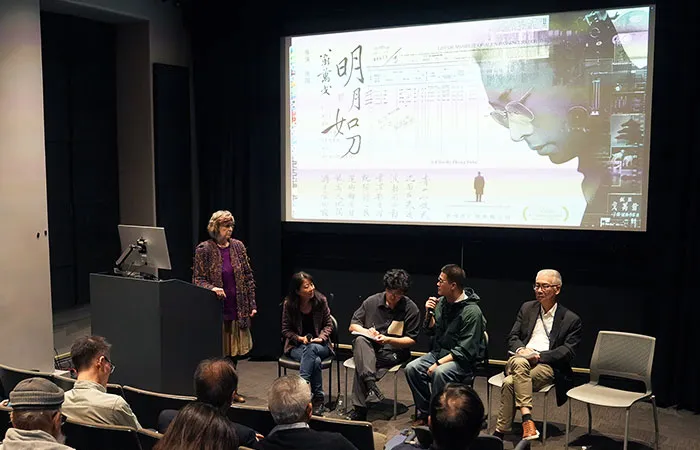
Prof. Jane Gaines (standing, left) leads the panel discussion at Dodge Hall on Oct. 16, 2026.
Zhang Yang’s documentary about Weng was inspired at least in part by his fortuitous discovery of the recording of the Weatherhead East Asian Institute’s March 2021 online program exploring Weng’s legacy. The hour-long documentary took four years to complete and sent Zhang and his crew to 10 cities in China and the US; they conducted interviews with dozens of scholars and Weng’s surviving family members and friends and uncovered rare archival footage that found its way into the film.
Their dedication was rewarded when I Will Be There After My Wandering (produced by the Suzhou Broadcasting System) received a nomination for Best Feature Documentary at the 15th China Documentary Academy Awards in Beijing last January.
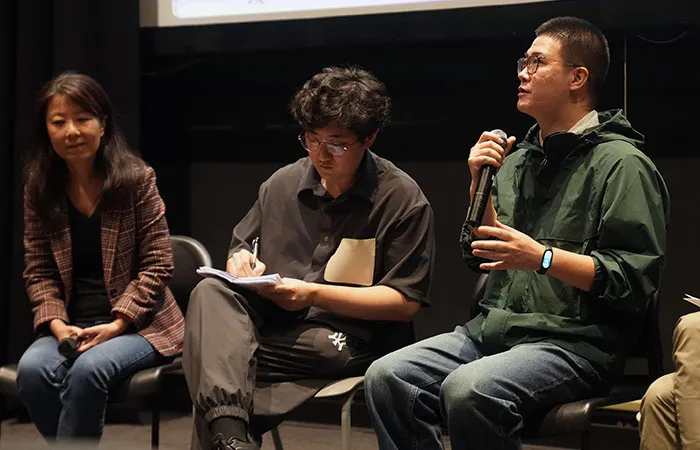
L–R: Professor Ying Qian, EALAC Phd student and interpreter Yilun Li, and filmmaker Zhang Yang at Dodge Hall on Oct. 16, 2026.
Prior to the October 16 screening at Dodge Hall, audience members heard from history professor Lien-Hang T. Nguyen, director of the Weatherhead East Asian Institute, and Associate University Librarian for Collections Chris Cronin. Both speakers lauded the collaboration between faculty and libraries that has kept this part of Chinese American history alive; Professor Nguyen added that the evening’s program demonstrated both the need for Asia studies to connect with diaspora studies and the importance of collecting and preserving unique primary resources for teaching and research.
After the screening, School of the Arts professor of film Jane Gaines moderated a panel discussion with Zhang Yang, Ying Qian of the Department of East Asian Languages and Cultures, and director of the C.V. Starr East Asian Library Jim Cheng. (Cheng and Professors Gaines and Qian are all interviewed in Zhang’s film.)
Professor Gaines opened by observing that I Will Be There. . . is framed as a kind of conversation between Zhang and Weng. With EALAC PhD student Yilun Li serving as his interpreter, Zhang agreed, explaining that he had at first responded to Weng primarily as a fellow filmmaker. He had never been interested, he said, in making a conventional biographical portrait but rather in letting his own process of discovery shape the narrative.
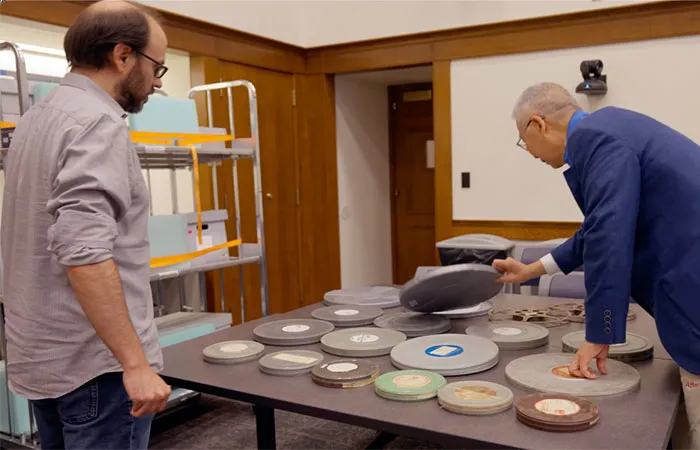
CU Libraries preservationist Jonah C. Volk and Jim Cheng organize film reels from the Wan-go Weng collection in I Will Be There After My Wandering (dir. Zhang Yang, 2025).
Elaborating on remarks Professor Qian makes in the film, Zhang acknowledged that the Weng portrayed in I Will Be There After My Wandering is something of a shape-shifting character. Though he was close with a remarkable number of prominent and influential figures like I. M. Pei and T. C. Hsu, Weng himself remains somewhat elusive, since he evidently preferred to act as a conduit for other people’s stories instead of sharing his own.
Cheng picked up on that thread by announcing that the C.V. Starr East Asian Library’s Weng collection has just been expanded by the addition of 25 boxes of Weng’s personal papers, which are still being sorted and archived. This new material, Cheng suggested, should make Weng’s life in the United States, and in particular his connections to local Chinese American communities, fruitful areas for further research and study. That offered grateful audience members the possibility that one day another Wan-go Weng event at Columbia may build on the October 16 program, just as it built on the one from five years earlier.
Watch the October 16 panel discussion (52:09)