
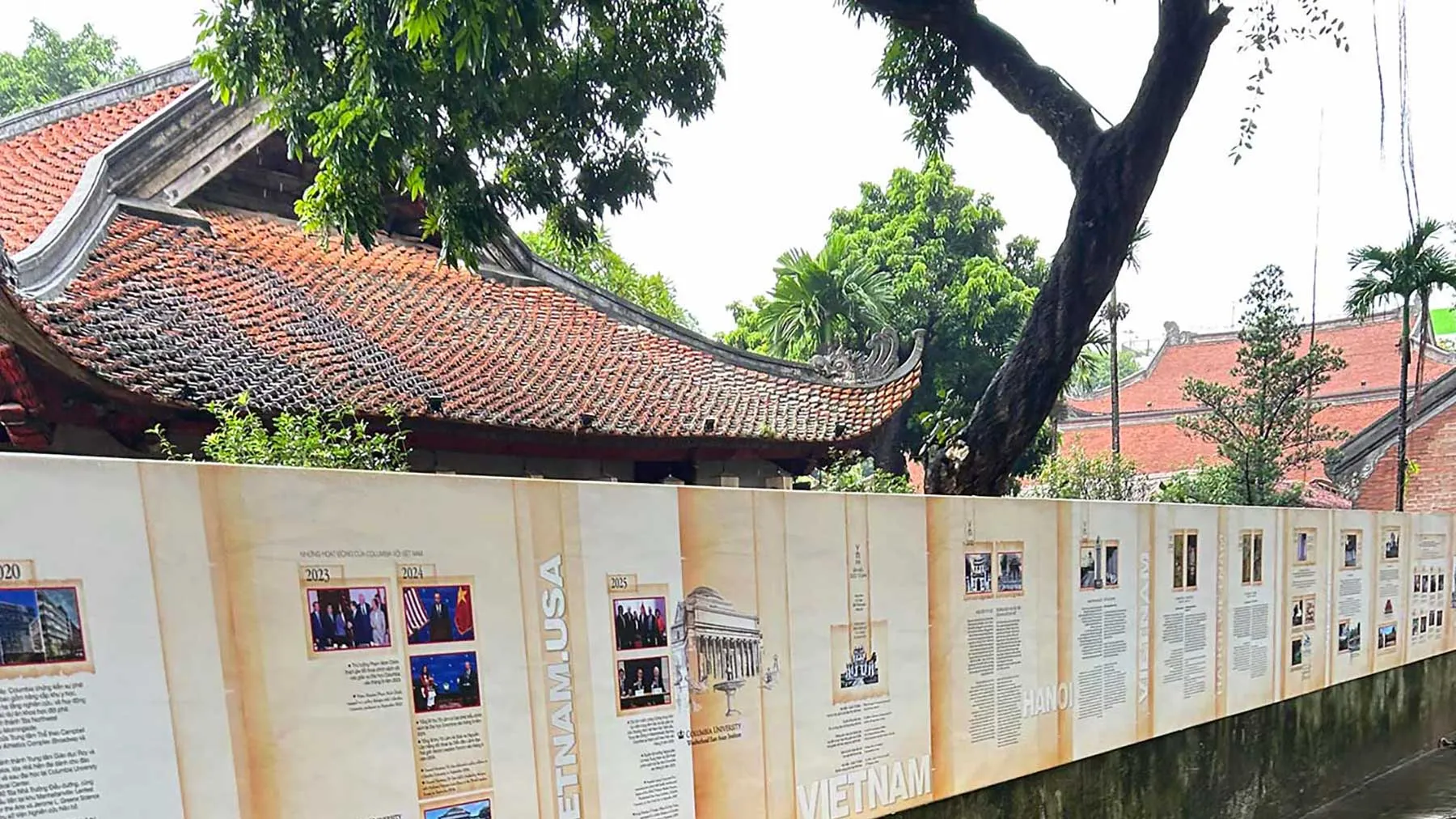
John Phan: A Vision for Global Vietnam Studies
At a storied site in Hanoi, EALAC Associate Professor of Vietnamese Humanities argues for an initiative “rooted in the past, but fixed on the future.”
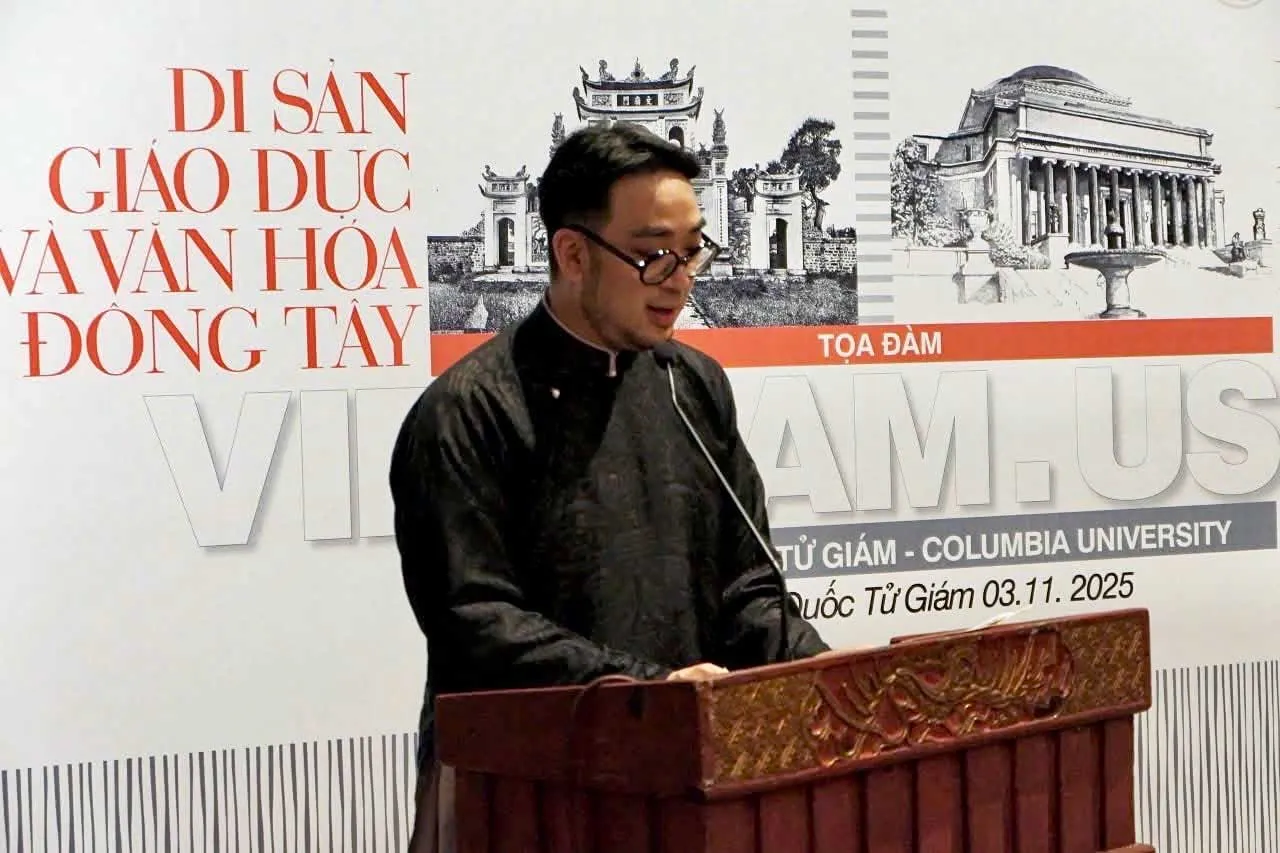
Remarks at the Temple of Literature–Quốc tử giám, Hanoi
November 3, 2025
Honored hosts and guests, good morning. My name is John Phan, and I am an Associate Professor of Vietnamese Humanities at Columbia University, specializing in the linguistic, literary, and intellectual history of Vietnam. It is a great honor to be standing here, in this space that has been hallowed to learning for nearly a thousand years. Mencius (Mạnh Tử) taught us that deference (辭讓 từ nhượng) is the sprout of Ritual Propriety (禮 Lễ)—the virtue that allows individual humans to transform into moral beings, elevating society in the process. To feel deference (từ nhượng), is to feel humility in the face of the sublime, in the face of something greater than yourself. It is easy to understand what Mencius meant by deference when standing here, in the Temple of Literature, where generations of students strove after Rightness (nghĩa) and Humaneness (nhân), in life, in practice, in their own hearts, and in society at large.
We are here today to honor a spirit of partnership between Columbia University and the educational traditions and institutions of Vietnam. I can think of no better place to do so than the Temple of Literature, consecrated to a vision of learning that prioritizes the formation of the human heart and mind (tâm), as anchor and also as compass for the development of a strong, just, and generous society. As Professor Liên-Hằng Nguyễn has already mentioned, Columbia has its own venerable (if somewhat younger) tradition of educational development, in the form of our celebrated Common Core program. The vision of the Common Core is to produce the critically thinking human being, a person who observes the world sharply, who questions intelligently, and who is always guided by two motivations: 1) to seek the truth; and 2) to improve the world. The motto of Columbia University is In Lumine Tuo Videbimus Lumen, a Latin phrase based on the Biblical Psalm 36:9, meaning “In your light, we see the light.” The original Hebrew psalm expresses the idea that only by the light of God is the light of truth illuminated. This idea is not so different from the core of traditional Vietnamese education as it was taught in this very place. Indeed, as the great educator-emperor Lê Thánh Tông once wrote:
Cố học quý hồ đốc chí, chí quý hồ tồn thành. Hành tắc ý chính, ý chính tắc tâm an. Tâm an nhi lý đắc, lý đắc nhi đạo minh.
故學貴乎篤志,志貴乎存誠。誠則意正,意正則心安。心安而理得,理得而道明。
Thus, in learning, what is precious is a devoted will, and as for will, what is precious is to abide in sincerity. If one is sincere, then Rightness [Nghĩa] is established. When Rightness is [Nghĩa] established, then the heart is tranquil. When the heart is tranquil, then Principle [Lý] is attained. When Principle [Lý] is attained, then the Way [Đạo] is illuminated.
Both the Hebrew psalm and the Emperor’s remarks teach us that to seek knowledge, one must seek it in the right manner. A context is needed, a compass is needed, a guiding principle. It is by the light of a sincere and steady mind (tâm) that true knowledge is finally attainable. The highest goal of both the Quốc tử giám and Columbia University is to provide that context and that compass for learning. In both the East and the West, then, our shared purpose is to cultivate this kind of sincere and steady mind—so that we may, in turn, put true knowledge into practice, for the betterment of our society. Only then are innovation and progress possible.
Fourteenth-century master educator Chu Văn An, who is enshrined in this very Temple of Literature, is often attributed with the idea that knowledge gives us eyes, while doing gives us feet, but that it is our duty to marry the one to the other for the betterment of the world. So, also, do we at Columbia believe in training critical minds—not to sit idle in libraries or classrooms—but to go out into the world and to effect change for the better.
So, against all odds, as different as we seem to be, it appears that both Columbia and this historic institution share a common vision for humanity: one in which the spirit is trained under expert guidance, to gather knowledge, and to transform the world.
Columbia’s program in the Common Core is celebrated around the globe. And yet, the Vietnamese tradition I have just mentioned is far older. That tradition, the tradition of this Temple of Literature, produced kings and emperors, ministers and poets, counselors and heroes for centuries. And yet, how many people around the world have heard of Lê Thánh Tông, of Chu Văn An, Nguyễn Trãi or Nguyễn Bỉnh Khiêm? How many people beyond Vietnam have smiled at the wit of Hồ Xuân Hương, been moved by the suffering of the Lady Kiều, or inspired by the conviction of Lê Lợi? Too few.
At the same time, it is undeniable that the poets, heroes, and thinkers of China, Japan, Korea, or Tibet have attained fame and attention from around the world, and—now this is the key point—that that fame and attention has in turn invited immense international investment and development. A critical part of this is due precisely to the development of educational programs on Chinese, Japanese, Korean, and Tibetan culture among leading institutions in the West.
What I am referring to are the top academic programs in Chinese studies, Japanese studies, Korean studies, or Tibetan studies in places like Harvard, Princeton, Yale, and certainly, Columbia. These programs have produced generations of top students who were both passionate and educated about these societies and cultures, and those students went on to become diplomats, entrepreneurs, scientists, and investors, who brought their expertise and their resources back to the places they once studied and fell in love with as a student. One of the great disadvantages faced by Vietnam today is the lack of commensurate academic representation in this manner. Here, Columbia’s burgeoning program in Vietnamese Studies is playing a critical role, by amplifying Vietnam’s global profile.
Now, it is true that Vietnam has developed tremendously over the past few decades. And yet, global awareness of Vietnam—its culture, its society, its contributions to human civilization, as well as its unlimited potential for the future—is still comparatively low, struggling to compete. In this regard Vietnamese development has reached a critical juncture, at which point the kind of global investment that transformed other parts of Asia over the past 50 years could be redirected here to similar or greater effect. But for that investment to come, global interest in Vietnam must be raised, and that interest comes not only with direct economic or diplomatic opportunities, but with soft cultural power.
This is where a program like Columbia’s Global Vietnam Studies can make a key difference. Columbia is a megaphone for Vietnam, it is a place where Vietnamese culture, society, history, and indeed, potential for the future can be directly transmitted to the best and the brightest around the world—in fact, to the world’s future leaders. To invest in Columbia’s Global Vietnam program, is to invest in Vietnam. To strengthen our program, is to amplify Vietnam’s profile around the world, and thus to enhance virtually every sector of development.
But how does Columbia’s program in Global Vietnam Studies do this? By marrying the special vision of the Common Core to the specific strengths, values, and richness of Vietnamese culture. This what we do, and it is no less than revolutionary: in our program, we continue to train the Columbia University critical thinker, by using the poetry of Trần Nhân Tông, the incisive commentary of Ngô Sĩ Liên and Lê Quý Đôn, the shrewd passion of Phan Bội Châu and Phan Chu Trinh. Our program shapes the minds of future leaders, setting them on the right path for global engagement and progress, and it does so by helping them to fall in love with Vietnam. Make no mistake, when our students leave the program, they will bring Vietnam forward in their hearts, wherever their careers lead them. And that is as it should be, because, as this beautiful and historic setting demonstrates, Vietnamese thought, Vietnamese literature, Vietnamese history and language and culture, belong on a global stage.
I have spoken a lot about the great figures of the Vietnamese past, partly because we stand here in such an historic place, also partly because that is my specific expertise. But I don’t want to give you the wrong impression. Our program is rooted in history, but it looks to the future.
There is no clearer demonstration of this than our embrace of digital technology and Artificial Intelligence, in the form of our Digitizing Vietnam initiative. Digitizing Vietnam is a new program begun with a seed grant from the Luce Foundation, focused on harnessing the power of digital technologies and AI to enhance, enrich, and revolutionize the study of Vietnam. Although we are merely in our infancy, our program has already revolutionized digital access to knowledge on Vietnam by releasing several unprecedented online libraries, a new set of digital tools for annotation and analysis of textual materials, special dictionaries, tools and resources for the decipherment and study of Chữ Nôm, as well as a range of other resources in collaboration with numerous partners both within and beyond Vietnam.
Our next phase of development will incorporate AI into every level of our project, including the development of an interactive AI assistant that will guide users to explore the rich culture, literature, and history of Vietnam based on the curated and verified materials of our collections. Most importantly, as evidenced by our close partnership with Fulbright University in Ho Chi Minh City, Digitizing Vietnam provides a platform for young and ambitious Vietnamese to learn about digital technologies and AI, and to apply that learning in new and innovative ways. Thus, Digitizing Vietnam is much more than a groundbreaking new resource for all levels of research on Vietnam, it is an institutionalized hub of opportunities for educational and professional advancement for young Vietnamese everywhere.
Columbia’s Global Vietnam Studies program has leapt quickly to the cutting edge—not only of programs in Vietnamese Studies, but in greater East and Southeast Asian Studies, as well as in interdisciplinary global and digital humanities overall. It is this program, rooted in the past, but fixed on the future, that is amplifying awareness of Vietnam around the world.
But it is in a perilous state. As the history of Văn Miếu – Quốc tử giám itself demonstrates, programs need support to survive, and to do the work that they promise to do. Our program is not yet secure. Our hope is to establish a lasting, permanent center for Global Vietnam Studies, on the same level as or exceeding that of Columbia’s centers of Chinese, Korean, Japanese, and Tibetan Studies. A center would allow us to continue leading research on Vietnam and spreading both awareness of and investment in Vietnam to the next generation of world leaders. Without support, all our initiatives will die on the vine, and this unique opportunity to establish a lasting, globally influential center for Vietnamese studies will fade away. We need your partnership. We need your help.
I will close my remarks by returning to the immortal words of Emperor Lê Thánh Tông, whose singular reign transformed Vietnamese education forever. In the same passage that I quoted earlier, the Emperor continues:
既有得之於己,又當推以及人。
Ký hữu đắc chi ư kỷ, hựu đương suy dĩ cập nhân.
Having attained [learning] for oneself, one must then extend it to others.
It is our hope that we at Columbia Global Vietnam Studies will be able to honor the Emperor’s message, and, like the Quốc tử giám has for centuries upon centuries, continue to spread right learning and true knowledge to the new generation, so that they may build a better future for us all. Thank you.
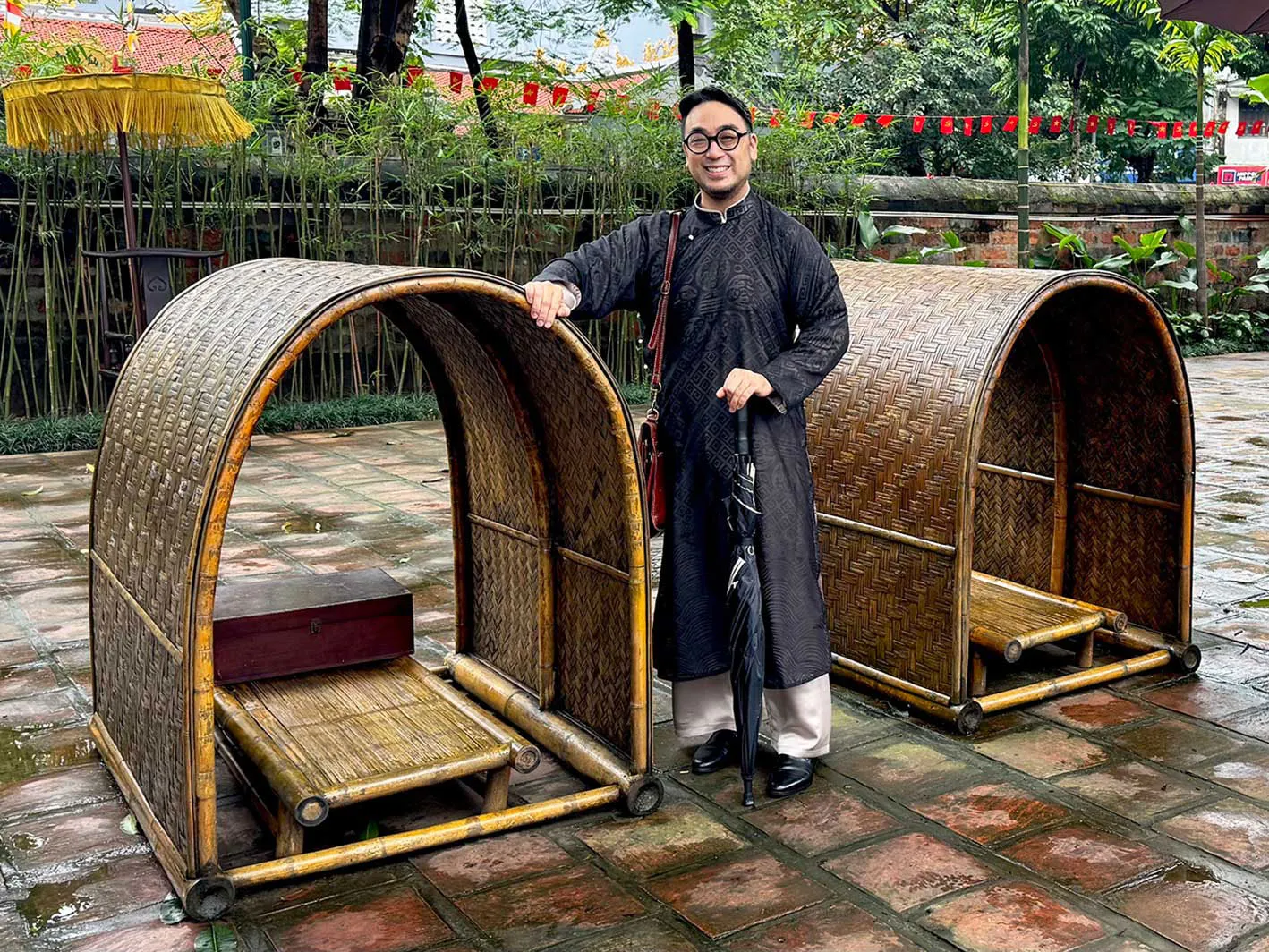
Above: John Phan at the Temple of Literature–Quốc tử giám in Hanoi on Nov. 3, 2025. Phan is standing between two of the bamboo tents (lều chõng in vernacular Vietnamese) that were built as examination cells for examinees in Vietnam’s traditional civil service examinations.