
Columbia Summer in Itoshima
Ecology and Society in Rural Japan

Above: "Sacred couple" rocks in Itoshima, Japan. (Shinichi Kotoku / Unsplash)
- Apply for the 2026 program (undergraduates and MA students)
- 2026 Itoshima PhD Summer Fellowships
The Weatherhead East Asian Institute announces Columbia Summer in Itoshima (formerly The Unson Microcollege Program), a new summer program in Itoshima, Japan. The program is offered in partnership with the Unson Foundation, a nonprofit foundation that exists to study the most challenging social and environmental problems generated by capitalism and to help build new social systems that will foster long-term human wellbeing.
For the Unson Microcollege's inaugural year, the Weatherhead East Asian Institute awarded summer research fellowships to Columbia University PhD students who assisted with planning for the new program in a survey trip to Itoshima from July 21 through 30, 2025.
Read the Summer 2025 Survey Trip Report
Unson Microcollege 2025 Personnel
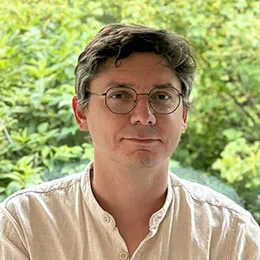
Paul Kreitman
Unson Microcollege Program Director
Paul is Unson Microcollege Program Director and an associate research scholar at the Weatherhead East Asian Institute. His research interests include Japanese history, environmental history, migration history, and Pacific history. He received his PhD in History from Princeton in 2015, and since 2016 has taught and researched in various capacities at Columbia: the Department of East Asian Languages and Cultures, the Department of History, the Heyman Center for the Humanities, and the Weatherhead East Asian Institute. His article "Attacked by Excrement: The Political Ecology of Shit in Wartime and Postwar Tokyo" was published in the journal Environmental History in 2018 and won the Association for the Study of Environmental History's Leopold-Hidy Prize. His monograph Japan's Ocean Borderlands: Nature and Sovereignty was published by Cambridge University Press in 2023. He has taught a range of courses on Japanese history as well as upper-level courses on "Asian Mobilities," "Japan 1968," "Troubled Islands of the Indo-Pacific," and graduate seminars on "Borderland Japan," “Introduction to Historical Interpretation and Methods” (GR8910), and "Science, Environment and Technology in Japanese History." His writing has also appeared in The Financial Times, The Japan Times,Asahi Shimbun, Tōyō Keizai Online, and The New Statesman. He is currently researching the history of labour migration regulation in the Pacific plantationocene.
Paul has also been a junior research fellow at the University of London's Institute of Historical Research, a senior teaching fellow at SOAS, University of London, a Japan Foundation visiting researcher at the University of Tokyo, and a JSPS visiting fellow at Osaka University. Before entering academia he worked as a carbon offset consultant at Mitsubishi UFJ Securities in Tokyo, accrediting greenhouse gas emission reduction projects under the Kyoto Protocol.
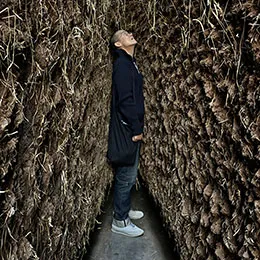
Junho Peter Yoon
Assistant Director
Junho Peter Yoon is the Assistant Director of the Center for Korean Research and Unson Microcollege Program at the Weatherhead East Asian institute. His research encompasses various fields, namely critical theory, cultural studies, ethics, and ecological thought, among others. In his doctoral dissertation project at New York University, tentatively titled "Toward Planetary Ethics," Junho traces the contours of what ethical thought and action might look like in the age of Anthropocene, contextualizing this inquiry through modern and contemporary Korean history, literature, and cinema. He holds an interdisciplinary M.A degree from University of Chicago, and a B.A in Comparative Literature from Rutgers University.
He has also previously worked with journals and various cultural institutions like e-flux Journal and Screening Room as a fellow, Literature Translation Institute of Korea (LTIK), and New York Asian Film Festival (NYAFF). He is currently co-editing two special issues on global Asian photography and the archive, and posthuman visuality in contemporary South Korean art and media.
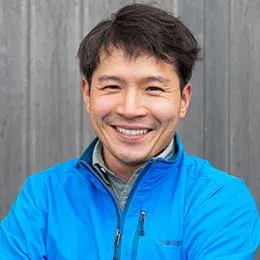
Masanori Seto
Program Researcher
Masanori Seto is the founder and director of NPO Soma, a Fukuoka-based organization dedicated to forest restoration, traditional land stewardship, and ecological education. He earned his PhD in Entomology from Cornell University, where he specialized in soil organisms, spatio-temporal dynamics, and the interplay between hydrology, biodiversity, and human land use. He now applies this scientific training to practical conservation projects across Japan.
In partnership with the Unson Foundation, Seto has been working to restore the soil drainage systems in the ancient shrine groves of Dazaifu Tenmangū, where centuries-old trees have been threatened by urban runoff and soil compaction. His approach combines ecological assessment with historical landscape knowledge and has helped establish new standards for managing sacred woodlands in densely settled regions. He also serves as a program researcher and key community partner for the Columbia Summer in Itoshima program, connecting students with the ecological systems, historical landscapes, and human networks that shape contemporary Japan.
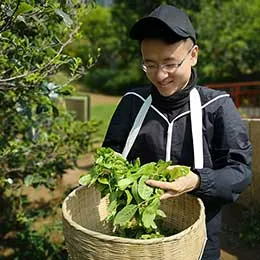
Xuexin Cai
2025 Fellow
Xuexin Cai grew up in a farming family in northwest China, where his parents cultivated vegetables and fruits in fields both nourished and threatened by the Yellow River. There, his interest in agriculture and in relations between human beings and the more-than-human world first took root. At 15, he left what had become a disappearing village on the edge of a rapidly expanding industrial city to continue his education in Singapore on a scholarship. He later completed his undergraduate studies in the Middle East on another scholarship before returning to China to live and work in Yunnan, a mountainous province in the southwest and the focus of his undergraduate research on tea production and trade.
In Yunnan, Xuexin served as a teacher and vice principal of a village primary school in a multiethnic region, where he began learning from local residents about the socioeconomic and environmental challenges experienced by different generations and ethnic communities. He also began collaborating with friends, colleagues, and local and external partners to build a safer, healthier, and more diverse and sustainable learning and living environment for students and teachers. These years in Yunnan profoundly shaped his research interests and methods, paving the way for his current doctoral work at Columbia University.
Xuexin's PhD research combines archival and ethnographic approaches to explore the socio-environmental history of southern Yunnan, one of the world’s most biologically and culturally diverse regions. Just as his research is deeply rooted in place while attentive to transregional forces and comparative perspectives, Xuexin believes in the power of place-based learning that engages thoughtfully with issues across spatial scales. In both his scholarship and teaching, he strives to break down the artificial boundaries between intellectual and manual work, and between the human and the natural.
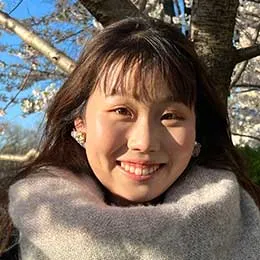
Mako Miura
2025 Fellow
Mako Miura is a doctoral student in the Anthropology and Education program at Teachers College, Columbia University. She is a sociocultural and linguistic anthropologist in training, studying the interactions among young children in multicultural and multilingual early childhood classrooms in Osaka, Japan. Her dissertation research examines what happens when two- and three-year-old children from Vietnam, China, South Korea, and the Philippines who draw on a multimodal mix of verbal and extraverbal expressions spend time with one another in Japanese classrooms with peers speaking different languages.
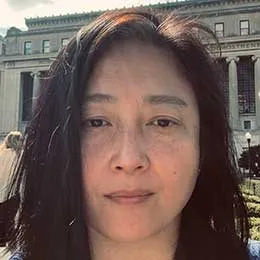
Catherine Miki Otachime
2025 Fellow
A doctoral student in Columbia University's Department of Religion, Catherine Miki Otachime approaches the study of religion through a deeply interdisciplinary and intercultural lens, with a particular focus on the premodern world. Her research explores the affective and sensory dimensions of faith—how religious systems shape perception, cognition, and embodiment across cultures. She is especially interested in non-rational modes of knowing—ritual, sound, image, and symbol—that challenge dominant epistemologies and offer alternative ways of engaging with the world.
Catherine is currently examining the cultural and religious interactions between medieval and early modern Japan and the Mediterranean world. More specifically, her current work centers on early modern encounters between Japanese and Iberian missionaries, leaders, merchants, investigating how visual, auditory, and ceremonial practices mediated dialogue between polytheistic and monotheistic traditions. She examines how religious and aesthetic frameworks translated complex metaphysical ideas across linguistic, cultural, and ideological boundaries.
Catherine’s academic background spans literature, art history, anthropology, Japanese religions (Shinto and Buddhism), and the fine arts—including painting and traditional woodblock printing. She has studied in Brazil, Japan, France, and the United States.