
Latest Issue of The Reed Explores ‘Asian Studies in Troubled Times’
In dialogue with Morris Rossabi's memoir of Columbia in the ’60s, three students share their understanding of Asian Studies in a moment of turmoil.
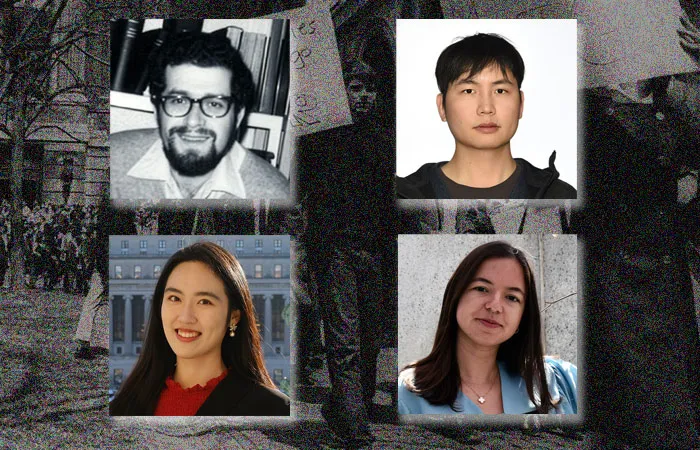
2026 contributors to The Reed, clockwise from top left: Professor Morris Rossabi, Hekang Yang, Irene Souny, and Sheena (Xinwen) Liang.
The Weatherhead East Asian Institute is pleased to announce that the latest issue of its annual journal The Reed is now available as both a downloadable PDF and in a limited number of print copies.
This year’s call for submissions to The Reed asked:
“What does it mean to study Northeast, Southeast, and Inner Asia now, in another moment of geopolitical turbulence? Share your understanding and experience of Asian Studies in a moment of extraordinary turmoil.”
Our call was partly a response to real-world events—most obviously to a war that has caused severe spillover effects in the Asian countries we are dedicated to studying. It was also prompted by our grateful receipt of an essay that Professor Morris Rossabi of the Department of East Asian Languages and Cultures generously offered us during the past academic year.
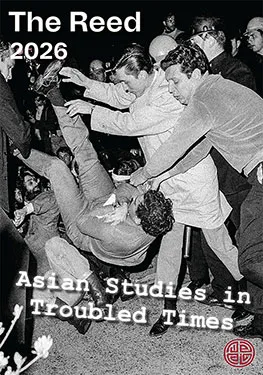
That essay is “There Would Be Reverberations: Columbia in the 1960s,” a memoir of graduate work in East Asian Studies, both at Columbia University and elsewhere, against a backdrop of growing political unrest and seismic cultural change. Professor Rossabi begins his personal chronicle in the fall of 1961, when an almost genteel environment still prevails on the Morningside Heights campus; he ends it back at Columbia as a newly minted PhD in spring 1970, when the Kent State and Jackson State shootings in the aftermath of America’s incursion into Cambodia sparked a fresh round of anti-Vietnam War demonstrations and campus division. Morris writes, in his magisterial conclusion, “The 1960s at Columbia had an extraordinary influence on me and my generation at the university.”
The three essays we selected from this year’s submissions, one First Prize-winner and two runners-up, respond to our prompt with a variety of approaches, from the more historically grounded to observation rooted in personal experience to a more speculative, even philosophical vein.
- Our First Prize-winner is “Frontiers of Crisis: Asian Studies in an Age of Uneven Globalization,” by EALAC doctoral student Hekang Yang. Hekang draws on his extensive research into the border zones between late imperial China and Russia to argue that an intellectually honest Asian Studies must reckon with the asymmetrical nature of globalization. In Hekang’s telling, the perennially marginalized frontier regions he studies offer a window into understanding the roots of present-day tensions and demonstrate the need for “histories that move across linguistic, political, and institutional boundaries.”
- Xinwen (Sheena) Liang, an MPA candidate in the School of International and Public Affairs (SIPA), contributes a more personal history in “Between Memory and Dialogue,” the first of our two runner-up essay winners. Sheena describes her participation in a 2025 Osaka “youth summit” that convened students from China, South Korea, and Japan; the face-to-face encounters she enjoyed there, all marked by a spirit of curiosity and openness, became a counterweight to what she had learned from stories of her family’s experiences in WWII.
- In the provocative “Beyond the Other—Why Studying Asia Matters Now,” Irene Souny (GS ’26) posits Asian Studies as a means of transcending the kind of blinkered Western perspective on present-day turmoil in which “every rupture is read as unprecedented, every crisis as uniquely severe.”
We thank all four of our writers for providing us with such lively reading, and hope that our community will find their contributions as stimulating as we have.
Print copies of this year’s Reed are available in the Weatherhead office on the 9th floor of the International Affairs Building. And for anyone who’s inspired by the new issue, a call for submissions for the 2027 Reed will appear in this space later in the academic year.