
Tô Lâm Advances Vision for US–Vietnam ‘Shared Responsibility’ in New York Speech
“Vietnam is ready to work with the United States,” leader says in affirmation of bilateral partnership.
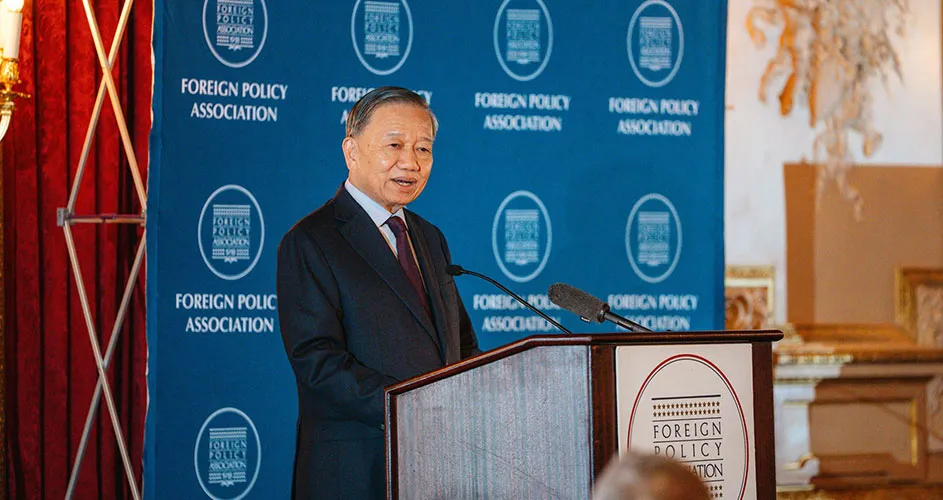
Vietnamese President Tô Lâm at The Metropolitan Club in New York City on Sept. 22, 2026. (Grace Wu/Foreign Policy Association)
Vietnamese President and General Secretary of the Communist Party Tô Lâm called for a deeper and more practical partnership with the United States during an address in New York on September 22, stating that the two former foes should build on their more than three decades of reconciliation by expanding economic, technological, educational, and diplomatic cooperation.
President Lâm was speaking at the Metropolitan Club in midtown Manhattan, at an event co-presented by the Weatherhead East Asian Institute’s Global Vietnam Studies program and the Foreign Policy Association (FPA) in conjunction with the United Nations General Assembly week.
The September 22 talk was the second half of a comprehensive programming one-two that demonstrated Global Vietnam Studies’ commitment to a range of disciplines. The prior evening, at the Brooklyn Academy of Music’s Howard Gilman Opera House, Global Vietnam Studies’ Viet Arts in Action initiative presented a unique multimedia “cine-concert” featuring the Ha Noi Philharmonic Orchestra and excerpts from classic Vietnamese films. President Tô Lâm also addressed the capacity crowd at that sold-out event.
Fittingly, the Columbia community was amply represented among the 175-strong audience at the Metropolitan Club. Among the attendees were Merit E. Janow, Professor of Practice in International Economic Law and International Affairs at the School of International and Public Affairs (SIPA); Professor Amy Hungerford, the Executive Vice President and Dean of the Faculty of Arts and Sciences; Duy Linh Tu, Dean of Academic Affairs and Professor of Professional Practice at the Columbia Journalism School; Hien Le and Thomas Valelly, Program Manager and Lead and Distinguished Fellow, respectively, for Weatherhead’s Vietnam Leadership Program; Phuong Chung Nguyen, Director of Columbia’s Vietnamese Language Program; Tony Bui, founding Director of Global Vietnam Studies’ Viet Arts in Action initiative; Weatherhead faculty members John D. Phan and Morris Rossabi, both of the Department of East Asian Languages and Cultures; and a sizable contingent of students.
Prior to the speech, FPA Chairman of the Board of Directors Henry Fernandez presented President Lâm with the Foreign Policy Association Medal, the association’s highest honor, which it bestows on individuals who demonstrate, in the association’s words, “a spirit of responsible internationalism and contribute to broadening public understanding of international affairs.”
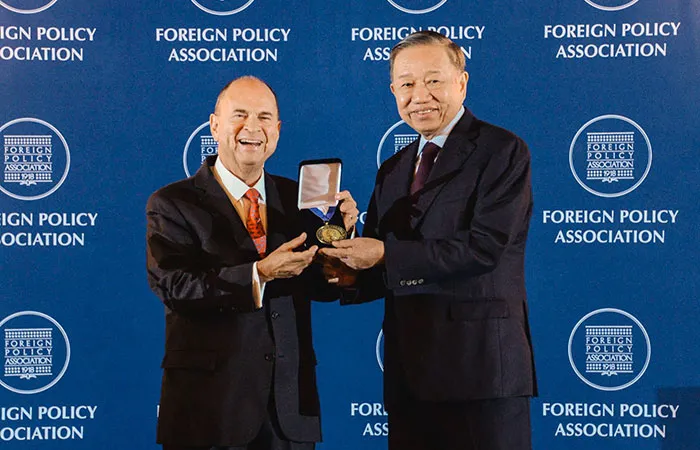
FPA Chairman of the Board of Directors Henry Fernandez presents Vietnamese President Tô Lâm with the Foreign Policy Association Medal on Sept. 22, 2026. (Grace Wu/Foreign Policy Association)
In his address, President Lâm offered the current state of U.S.–Vietnam relations as an example of how countries can move beyond conflict and mistrust. He also argued that the relationship should now deliver more tangible benefits—“concrete results of cooperation that the people of both countries can feel in their daily lives.”
President Lâm placed the bilateral relationship in a broader context of global uncertainty. “The world is undergoing epochal changes,” he said, noting how rapid advances in science and technology, particularly AI, are creating new opportunities while raising questions about how technology should be regulated and who gets to benefit from it.
At the same time, he said, a host of 21st-century threats are making international cooperation more difficult—which is why it’s imperative for all countries, regardless of their size, to contribute to maintaining international peace and stability. The president also reaffirmed the importance of sovereignty, non-interference, international law, and peaceful resolution of disputes.
President Lâm then turned to the history of Vietnam’s relationship with the US—beginning with a poignant reminder that the two countries first collaborated during World War II, when Viet Minh forces led by Ho Chi Minh worked with American personnel against Japanese occupiers. In a 1946 letter to President Harry Truman, Ho Chi Minh expressed a desire for a “full cooperative” relationship with the United States.
That early cooperation was followed, of course, by decades of war and division. President Lâm emphasized the years of effort that eventually brought the two countries to diplomatic normalization, particularly Vietnam’s cooperation in recovering the remains of American servicemen missing in action. He also credited American veterans like Bobby Muller and the former senators John McCain and John Kerry with helping to advance reconciliation.
For President Lâm, this history offers a lesson for the relationship’s next stage: Trust has to be sustained through practical cooperation.
He outlined five priorities. First, Vietnam wants to maintain political momentum through more high-level exchanges, stronger dialogue, and continued defense and security cooperation.
Second, he called for expanded trade and investment—to which end, he said, Vietnam is prepared to address American concerns about trade imbalances, market access, intellectual property, rules of origin, and supply-chain security, all in the interest of achieving a stable trading environment.
Finally, President Lâm called for closer U.S.–Vietnam coordination on regional and global issues. He said Vietnam supports a constructive American role in the Indo-Pacific and the central role of ASEAN, and identified further areas for potential cooperation, such as sustainable development in the Mekong region.
President Lâm concluded by returning to the central theme of his speech. The “tumultuous journey” of U.S.–Vietnam relations shows that reconciliation is possible, but maintaining it requires sustained effort. The task now, he said, is to turn the trust built over decades into “concrete results” for citizens of both countries.
Third, President Lâm identified science and technology as potential drivers of cooperation, highlighting semiconductors and AI as well as partnerships among universities, research institutions, and businesses. Vietnam, he said, also intends to strengthen protections for investors and intellectual property and improve data and cybersecurity.
It was in this context that, departing from his prepared remarks, the president acknowledged the Weatherhead East Asian Institute’s inaugural Vietnam Leadership Program of the month prior, a three-day summit on the Columbia campus that convened a high-level Vietnamese delegation with Columbia faculty and other experts to explore issues surrounding technological innovation and economic reform.
The president’s fourth priority was continued reconciliation over the legacy of the war, in areas like unexploded ordnance and demining. President Lâm also called for more educational exchanges to give younger generations in both countries opportunities to develop relationships of their own.
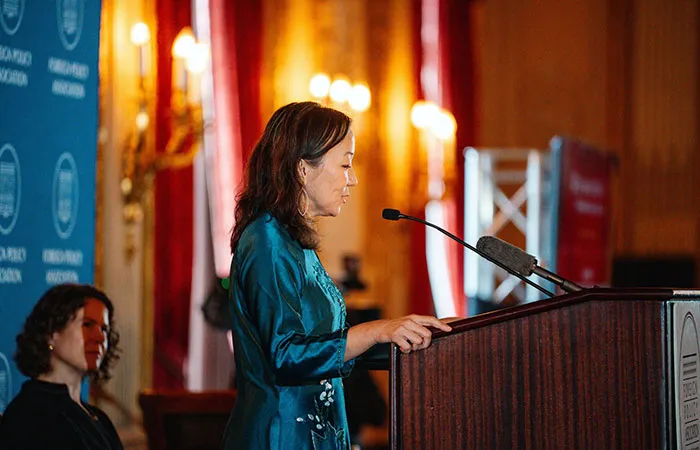
Columbia University Professor Lien-Hang Nguyen speaking at The Metropolitan Club on Sept. 22, 2026 (Columbia Dean Amy Hungerford seated, rear). (Grace Wu/Foreign Policy Association)
Two speakers representing Columbia University offered closing remarks. Dorothy Borg Associate Professor in the History of the United States and East Asia, Director of the Weatherhead East Asian Institute, and inaugural Director of Global Vietnam Studies Lien-Hang T. Nguyen thanked the president for acknowledging Global Vietnam Studies and linked its mission to his call for “sustained, two-way exchanges” between American higher education and leading institutions in Vietnam. The founding of a dedicated Global Vietnam Center on the Columbia campus, she continued, will definitively signal Columbia’s commitment to those kinds of exchanges.
Dean Amy Hungerford reaffirmed Columbia’s commitment to engagement with Vietnam and seconded Professor Nguyen’s call for a Global Vietnam Center in Morningside Heights—positing an institution that will grow to become a worldwide hub for the study of Vietnam and a “lasting platform” for collaboration between the two countries.
Official transcript of General Secretary President Tô Lâm’s speech (English translation)
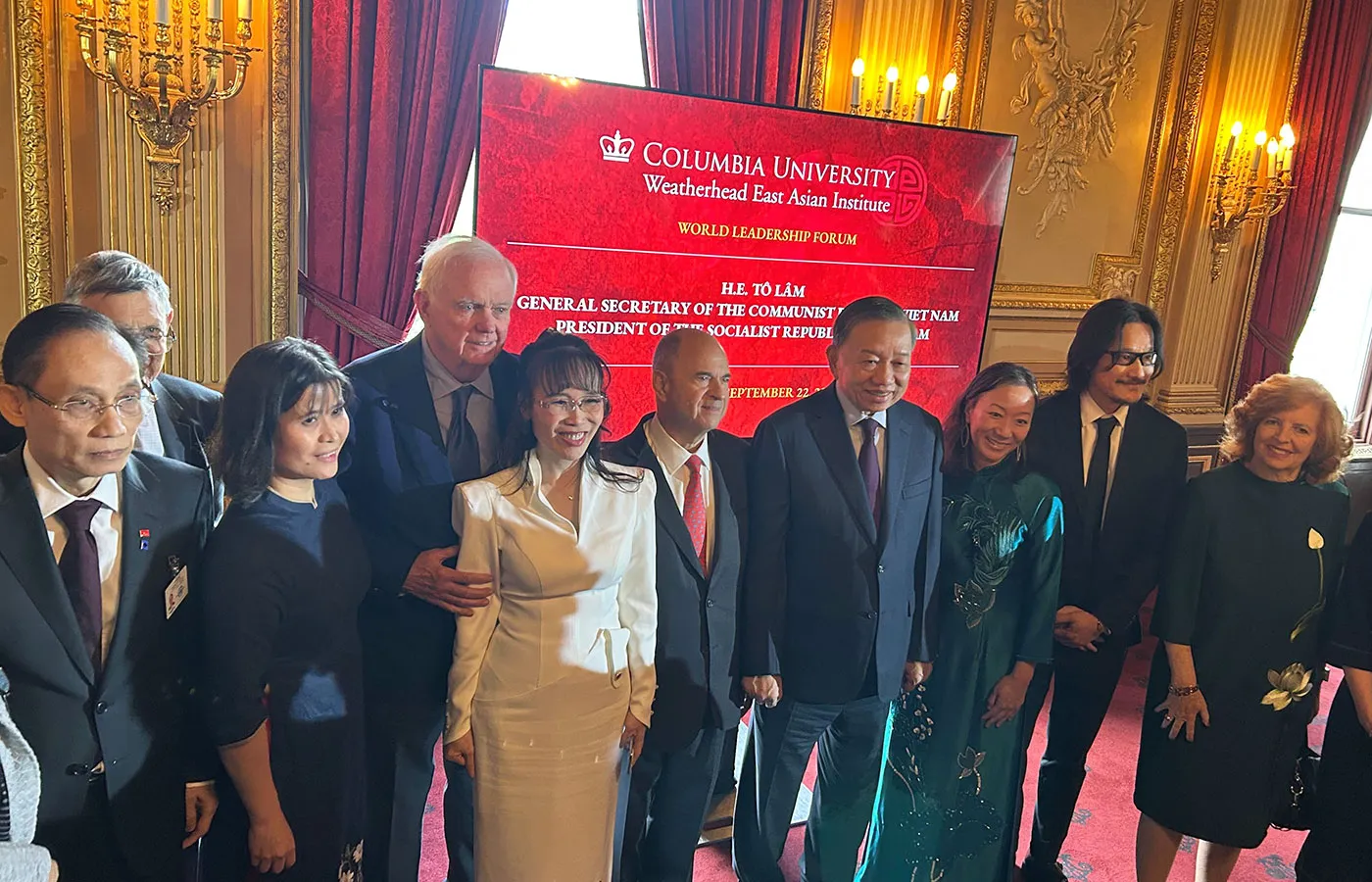
L to R: Foreign Minister of Viet Nam Le Hoai Trung; Hien Le, Program Manager, Vietnam Leadership Program at WEAI; Thomas J. Vallely, Distinguished Fellow, Vietnam Leadership Program; Nguyen Thi Phuong Thao, Chairwoman of VietJet Airlines; FPA Chairman of the Board of Directors Henry Fernandez; Vietnamese President Tô Lâm; Columbia University Professor and WEAI Director Lien-Hang T. Nguyen; Tony Bui, Director, Viet Arts in Action at WEAI; Professor Merit E. Janow, School of International and Public Affairs, Columbia University.
The Weatherhead East Asian Institute thanks The Foreign Policy Association for helping to make President and General Secretary Tô Lâm’s September 22, 2026 speech in New York City possible.
Vietnamese coverage:
Voice of Vietnam
Vietnam News Agency