
Vietnam Leadership Program Charts Course for Long-Term Economic Growth
Three-day campus summit pairs top-level governance with academic expertise to plot development strategies.
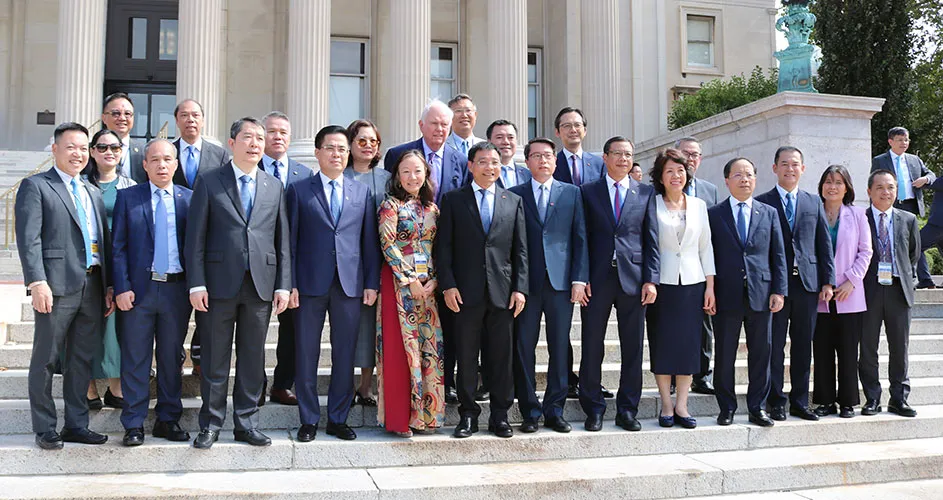
Members of the Vietnam Leadership Program delegation on the Low Library steps at Columbia University on Aug. 24, 2026. WEAI Director Lien-Hang T. Nguyen and Deputy Prime Minister of Vietnam Nguyen Van Thang are 5th and 6th from the left in the front row.
The Weatherhead East Asian Institute convened a multi-day, high-level policy summit on campus late this summer as Vietnamese government officials and experts from Columbia University and elsewhere met for the 2026 Vietnam Leadership Program (VLP).
Led by Vietnam’s Deputy Prime Minister Nguyen Van Thang, the August 24–26 conference in Faculty House focused on supporting Vietnam’s long-term economic objectives: reaching upper-middle-income status by 2030 and becoming a high-income developed nation by 2045 through sustained, double-digit growth.
Building on several years’ worth of executive leadership dialogues at Columbia, the program sessions aimed to equip policymakers with actionable strategies for reaching those objectives. Over a densely packed two-and-a-half days, speakers shared insights into, and suggestions for, fostering and regulating artificial intelligence (AI); digital finance; capital market reform; and the dynamics of global trade.
DAY 1: MONDAY, AUGUST 24, 2026
The program opened on Monday morning with keynotes outlining Vietnam’s growth trajectory and the scope of its cooperation with the United States. Deputy Prime Minister Thang introduced the week’s core policy priorities, which included the safe deployment of AI; expanded use of cloud computing; modernization of the banking sector; and other national strategies centered on advanced technology.
Weatherhead East Asian Institute Director Professor Lien-Hang T. Nguyen, Dorothy Borg Professor of History, framed VLP 2026 as a significant evolution of the Institute’s longstanding Vietnam Executive Leadership Program (VELP). She noted that because the agenda was meant to address structural challenges facing both the US and Vietnam, it would ideally provide a forum for candid policy exchange.
A well-received campus tour led by Phuong Chung Nguyen, Senior Lecturer in Vietnamese in the Department of East Asian Languages and Cultures, preceded Monday’s morning sessions.
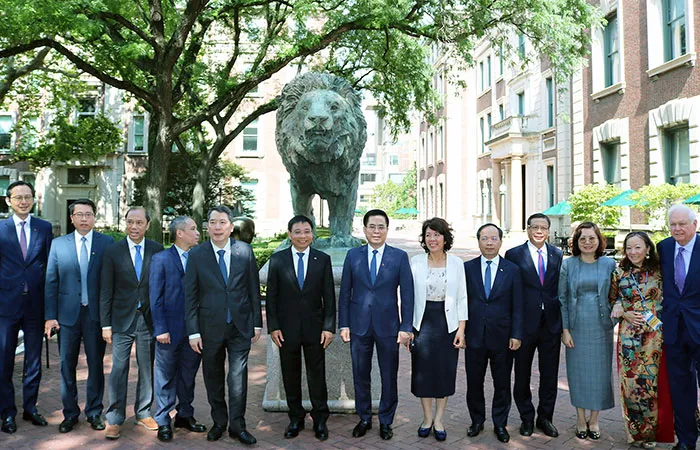
Members of the Vietnam Leadership Program delegation during the campus tour on Aug. 24, 2026.
Session I: US Politics and Its Impact on Trade Policy
Professor Robert Shapiro, Vice Dean of the School of International and Public Affairs (SIPA), Columbia University
Session II: Building AI Vietnam Can Trust
Richard Zemel, Professor of Computer Science, Columbia University
Session III: AI, Blockchain, and the Future of Global Finance
Topic 1: How AI and machine learning are transforming financial markets, asset management, and financial decision-making
Ali Hirsa, Professor of Professional Practice in the Department of Industrial Engineering and Operations Research, Columbia Engineering
Topic 2: How Blockchain Alters the Plumbing of Global Finance
Omid Malekan, Adjunct Assistant Professor of Business, Finance Division, Columbia Business School
Prat Vallabhaneni, Partner, White & Case
Session IV: Calibrating Policy with Growth Goals: The Need for Evaluation and Discussion
David Dapice, Professor Emeritus of Economics at Tufts University
DAY 2: TUESDAY, AUGUST 25, 2026
The summit’s second day shifted into sessions centered on how Vietnam can maintain its national growth model in the face of worldwide economic shifts like US-imposed tariffs and rerouted supply chains.
Session V: US–China Relations Today and Implications for Future Geopolitical Competition and Cooperation
Julian Gewirtz, IGP Senior Research Scholar, SIPA
Session VI: Enabling a Digital Financial Future: Cloud Policy and FSI Growth in Vietnam
Annabel Lee, Director of ASEAN Public Policy, Amazon Web Services
Session VII: The Future of Global Trade and Supply Chains
Topic 1: Economic Globalization & Shifts in International Trade
Merit Janow, Professor of Practice in International Economic Law and International Affairs at SIPA; Wendy Cutler, Vice President of the Asia Society Policy Institute
Topic 2: The Future of Global Supply Chains: Trade Policy Trends and the New Requirements for Transparency, Traceability, and Accountability
Evan Smith, CEO, Altana AI; Scott Friedman, Vice President of Government Affairs, Altana AI
Session VIII: Supporting Vietnam’s New Development Model: Banking Sector Modernization and Capital Market Deepening
Nguyen Xuan Thanh, Senior Lecturer in Public Policy at Fulbright University Vietnam
DAY 3: WEDNESDAY, AUGUST 26, 2026
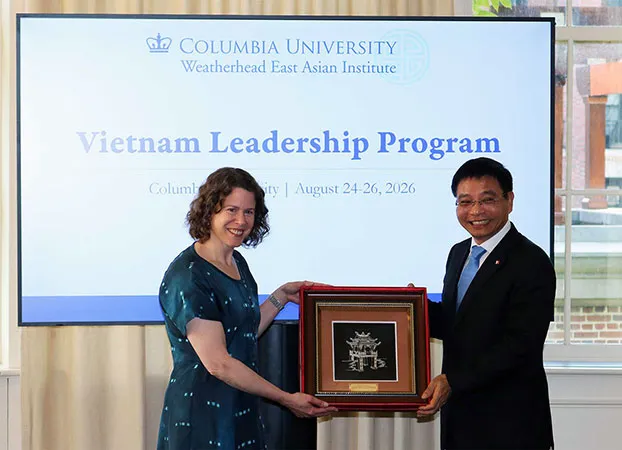
Columbia University Executive Vice President of Arts and Sciences and Dean of the Faculty of Arts and Sciences Amy Hungerford with Deputy Prime Minister of Vietnam Nguyen Van Thang on Aug. 26, 2026.
The summit concluded on Wednesday morning with a pair of speakers delivering targeted policy recommendations, followed by formal closing addresses.
Session IX: Vietnam’s Technology at the Crossroads
Thomas J. Vallely, Distinguished Fellow for the Vietnam Leadership Program, Weatherhead East Asian Institute, Columbia University
Thai Duong, founder and Chief, Calif
At the closing ceremony, Columbia University Executive Vice President of Arts and Sciences and Dean of the Faculty of Arts and Sciences Amy Hungerford thanked speakers and guests for the multi-dimensional discussions of preceding days, which in her view exemplified “the kind of dialogue that universities can help foster.” Dean Hungerford reaffirmed Columbia’s commitment to a long-term academic partnership with Vietnam, mentioning plans for joint research and teaching initiatives. “I hope we see this not as an ending,” she said, referring to the close of VLP 2026, “but as the beginning of continued dialogue, learning, and partnership.”
In his final remarks, Deputy Prime Minister Thang instructed attending ministry officials and delegates to analyze and integrate the program’s recommendations into upcoming national socio-economic policy planning and management strategy.
With the speeches concluded, a genial ceremony featured Weatherhead’s Professor Nguyen presenting attendees with certificates commemorating their participation in the summit.
Across three days, VLP 2026 reflected a shift in Vietnamese state policy toward a more self-reliant posture founded on state-of-the-art technology. Reiterating many of the conclusions of the Strategic Dialogue Forum that Weatherhead co-presented in Hanoi this June, the summit established that meeting Vietnam’s long-term economic targets will depend on a combination of upgraded financial infrastructure; the implementation of secure digital governance; and a move up the global value chain. The Vietnamese Leadership Program will continue to act as a forum for debate and discussion of these and related ideas; watch this space for further news of VLP activities and events.
Vietnamese media coverage:
Voice of Vietnam
Vietnam+