
Hanoi Forum Introduces Ambitious Plan to Move Vietnam Up the Economic Ladder
Prominent speakers argue for partnerships, private-public collaboration as crucial for transition to a smart economy.
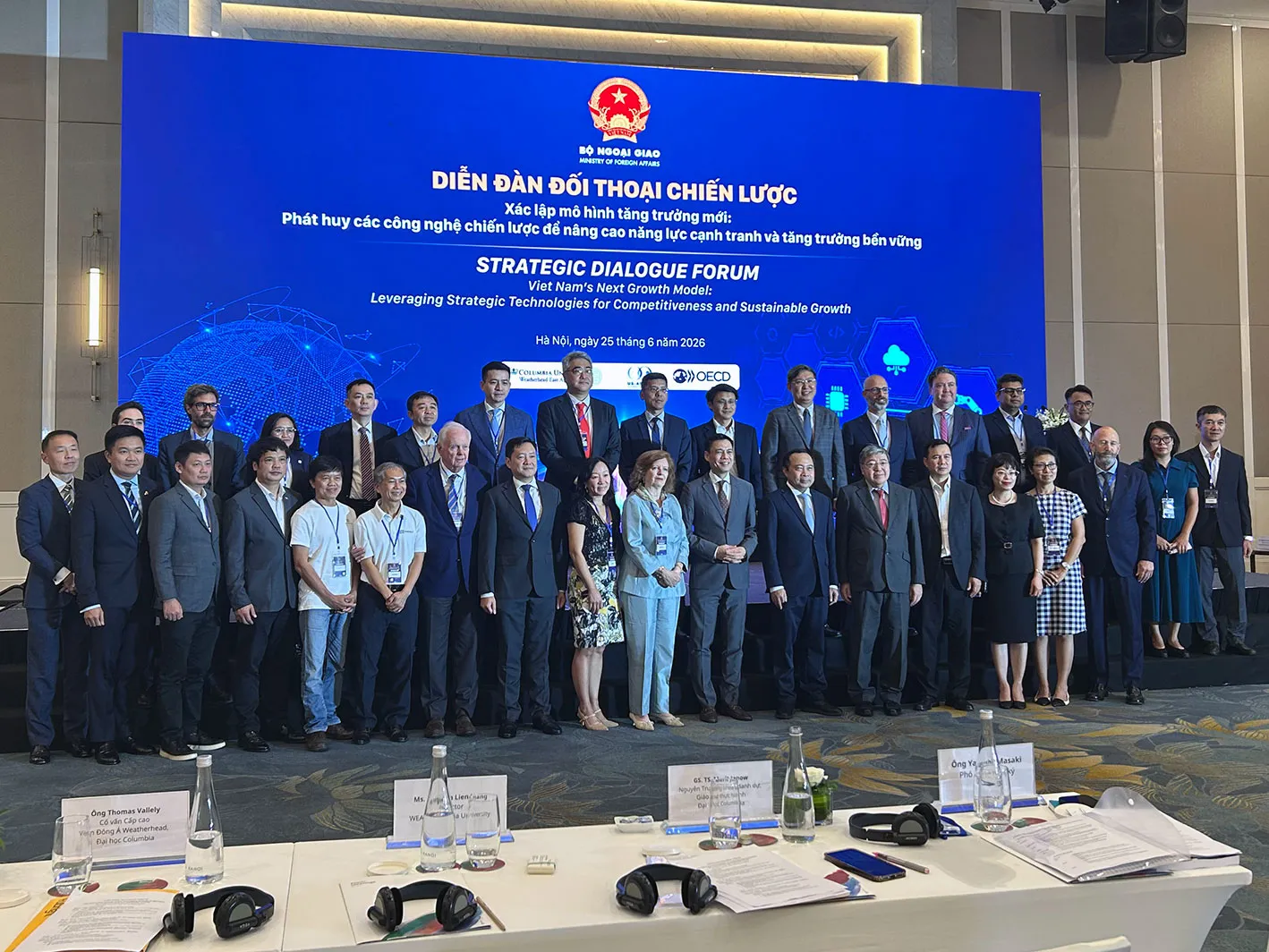
Participants at the Strategic Dialogue Forum in Hanoi on June 25, 2026.
Vietnam’s stunning economic rise over the past four decades has been driven by manufacturing, exports, foreign investment, and an abundant labor force. The combination of these four factors transformed the once war-ravaged nation into one of Southeast Asia’s fastest-growing economies.
But many policymakers and business leaders now believe that strategy has reached its limits. At the Strategic Dialogue Forum in Hanoi on June 25, they argued that Vietnam’s next stage of development will depend on innovation, advanced technology, and a more sophisticated workforce.
The forum, “Establishing a New Growth Model: Leveraging Strategic Technologies to Enhance Competitiveness and Sustainable Growth,” was co-hosted by the Weatherhead East Asian Institute, the US–ASEAN Business Council, and the Organization for Economic Cooperation and Development (OECD), along with Vietnam's Ministry of Foreign Affairs and Ministry of Science and Technology. The daylong gathering brought together government officials, business leaders, international organizations, and representatives from higher education to consider what it will take for Vietnam to stay competitive in such a rapidly changing global economy.
One clear message emerged from the day’s discussions. Future prosperity will depend less on cheap labor and natural resources than on a country’s ability to create knowledge, develop new technologies, and convert research into commercial success. Minister of Science and Technology Vu Hai Quan and Deputy Minister of Foreign Affairs Dang Hoang Giang both argued that the time has come for Vietnam to move past adopting technologies developed abroad and instead come up with its own innovations for which it can then find commercial uses.
That transition will require more than ambitious policies. Forum speakers saw a need for stronger institutions, clearer regulations, and closer cooperation among government agencies, universities, and private companies. Vietnam has already updated dozens of laws to encourage scientific research; increased public investment in science and technology; and expanded incentives for private-sector research and development. But as commendable as these regulatory reforms are, participants said, they need to be matched by practical measures that make it easier for researchers and businesses to innovate.
What might some of those practical measures be? Speakers posited computing capacity, secure cloud services, research facilities, cybersecurity, and programs that develop highly skilled workers as assets that, held in common, could strengthen collaboration between universities and industry while helping new technologies reach the marketplace more quickly.
International partnerships are likely to be just as important. Speakers suggested that rather than trying to develop every advanced technology independently, Vietnam concentrate domestic resources on strategic priorities while working with trusted partners in the US and elsewhere in fields like AI and semiconductor manufacturing. A wider network of partnerships, they argued, could expand access to technology while reducing strategic risk.
The opportunity to establish new relationships was a theme taken up by Weatherhead faculty member Merit E. Janow, Professor of Practice in International Economic Law and International Affairs at the School of International and Public Affairs (SIPA). Speaking at the U.S.–Vietnam Technology Luncheon embedded in the Strategic Dialogue Forum, Professor Janow noted that the world is fragmenting and restructuring rather than simply deglobalizing.
“The world is not standing still,” Professor Janow said. “Trade and economic integration continue, with considerable experimentation now underway.” That experimentation, she continued, creates a new environment in which “Vietnam appears to be taking a number of important steps,” such as the economic reforms earlier speakers had argued for along with the increased focus on technology as a driver of competitiveness.
The Strategic Dialogue Forum also highlighted a challenge that extends beyond the technology sector. Foreign direct investment has played a big role in Vietnam’s economic success, but much of it is still goes to assembly and manufacturing. Participants argued that future investment policies should place greater emphasis on technology transfer, workforce training, and partnerships that strengthen Vietnamese companies rather than simply expand production.
Several speakers pointed to encouraging signs that this transition is already under way. Vietnamese firms like Real Time Robotics (a drone manufacturer with offices in Ho Chi Minh City and California) and MoMo (a digital payment app) have shown that local companies can compete internationally by building their own technological expertise. Now the challenge is to turn these individual successes into broader national capabilities.
The forum concluded with broad agreement that Vietnam’s future competitiveness will depend on the quality of its innovation as much as the scale of its manufacturing. A lasting commitment to research, education, technology, and the workforce will be needed along with effective institutions and closer cooperation between government and business. The transition won’t be easy, speakers acknowledged, but moving up the technology value chain offers Vietnam its best opportunity for long-term, sustainable growth.
Download the Strategic Dialogue Forum agenda
Vietnamese press coverage:
Viet Nam News (English)
VN Express