
VLP Forum in DC Envisions a Shared High-Tech Future for Vietnam and the US
Top figures in government and business from both countries see collaboration around AI, semiconductors, and tech infrastructure as the next stage in the bilateral relationship.
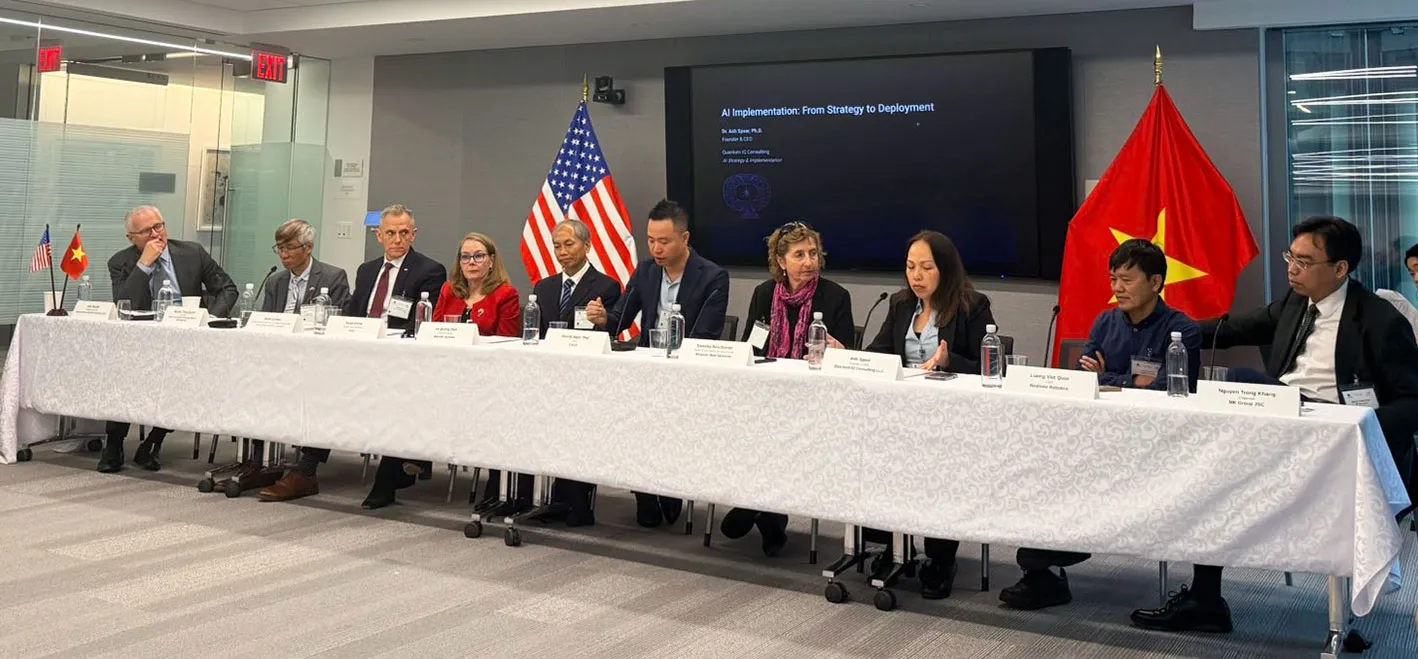
Above: Panelists in the session "U.S.–Vietnam Partnerships and Cooperation in Strategic Technologies" at the March 11 forum in Washington, DC.
In Washington, DC on March 11, the Weatherhead East Asian Institute’s Vietnam Leadership and Policy Program (VLP) co-hosted a high-level forum, “Strengthening US–Vietnam Relations through Technological Partnerships and Cooperation,” in partnership with the Embassy of Vietnam in the United States and the US–ASEAN Business Council.
As its name implies, the event focused on advanced manufacturing and cutting-edge technologies as potential areas for developing and solidifying ties between the two nations. Speakers foregrounded semiconductors, artificial intelligence, and cloud computing as some of the most promising opportunities for Vietnam and America to capitalize on each other’s strengths.
More than 100 participants attended the half-day forum. In the American delegation, former US Ambassador to Malaysia and current Interim President of the US-ASEAN Business Council Brian D. McFeeters and former US Ambassador to Bangladesh Peter Haas appeared alongside high-level officials from the US Departments of State and Commerce as well as senior figures at Intel, Qualcomm, and the 3M Company. Representing Vietnam were Vietnamese Ambassador to the US Nguyen Quoc Dung; leaders of major technology corporations and financial institutions like Luong Viet Quoc, founder and CEO of Realtime Robotics Inc., and Nguyen Trong Khang, founder and Chairman of MK Group; and representatives from several Vietnamese government agencies.
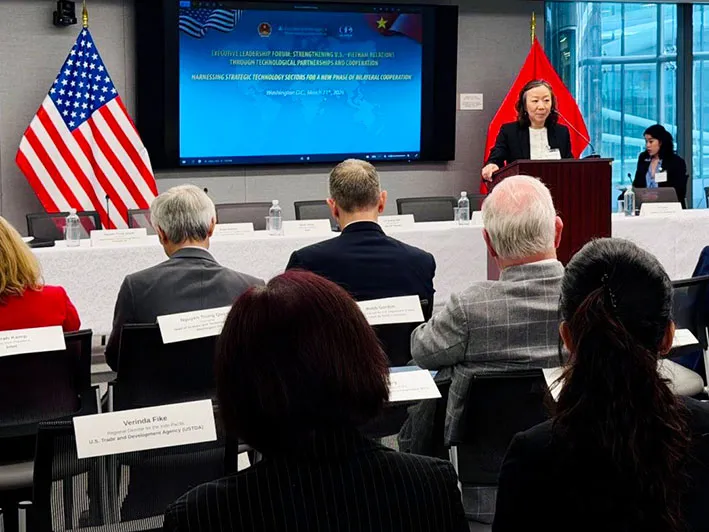
Weatherhead East Asian Institute Director Lien-Hang T. Nguyen addresses the forum in Washington, DC on March 11, 2026.
Weatherhead East Asian Institute Director Lien-Hang T. Nguyen opened the proceedings by thanking Vietnam’s Ministry of Foreign Affairs for making the day’s program (like the previous VELP activities it built on) possible. She then announced some of the day’s key themes before introducing Ambassador Dung.
In his keynote, Ambassador Dung posited technology as the new foundation for a deepening bilateral relationship. He emphasized the countries’ complementary strengths: the United States brings advanced technology, capital, and leading research institutions to the relationship, while Vietnam offers a fast-growing economy, a young, skilled workforce, and an emerging innovation ecosystem.
The ambassador argued that closer cooperation can build reliable technology networks, strengthen supply chains, and expand opportunities for innovators in both countries. Vietnam, he said, is developing an open legal framework and investing heavily in high tech to position itself as a dependable partner in American supply chains.
The remainder of the forum reinforced Vietnam’s appeal for R&D and high-tech manufacturing in some of the above-named sectors, with continued government support to attract concrete projects. Participants also focused on digital infrastructure and energy, calling for environmentally friendly data centers and energy-sector reforms to support semiconductor and AI production. US agencies, including the Export-Import Bank of the United States (EXIM) and US Trade and Development Agency (USTDA), expressed a willingness to finance key infrastructure projects.
Forum discussions also highlighted a shift toward technology flows going in both directions—for instance, Vietnamese firms are now exporting drones and AI software to the United States, signaling a step up the ladder from assembly into innovation.
All told, the VLP forum pointed to a more mature partnership between Vietnam and the United States, with both countries intent on shaping the next phase of technological cooperation.