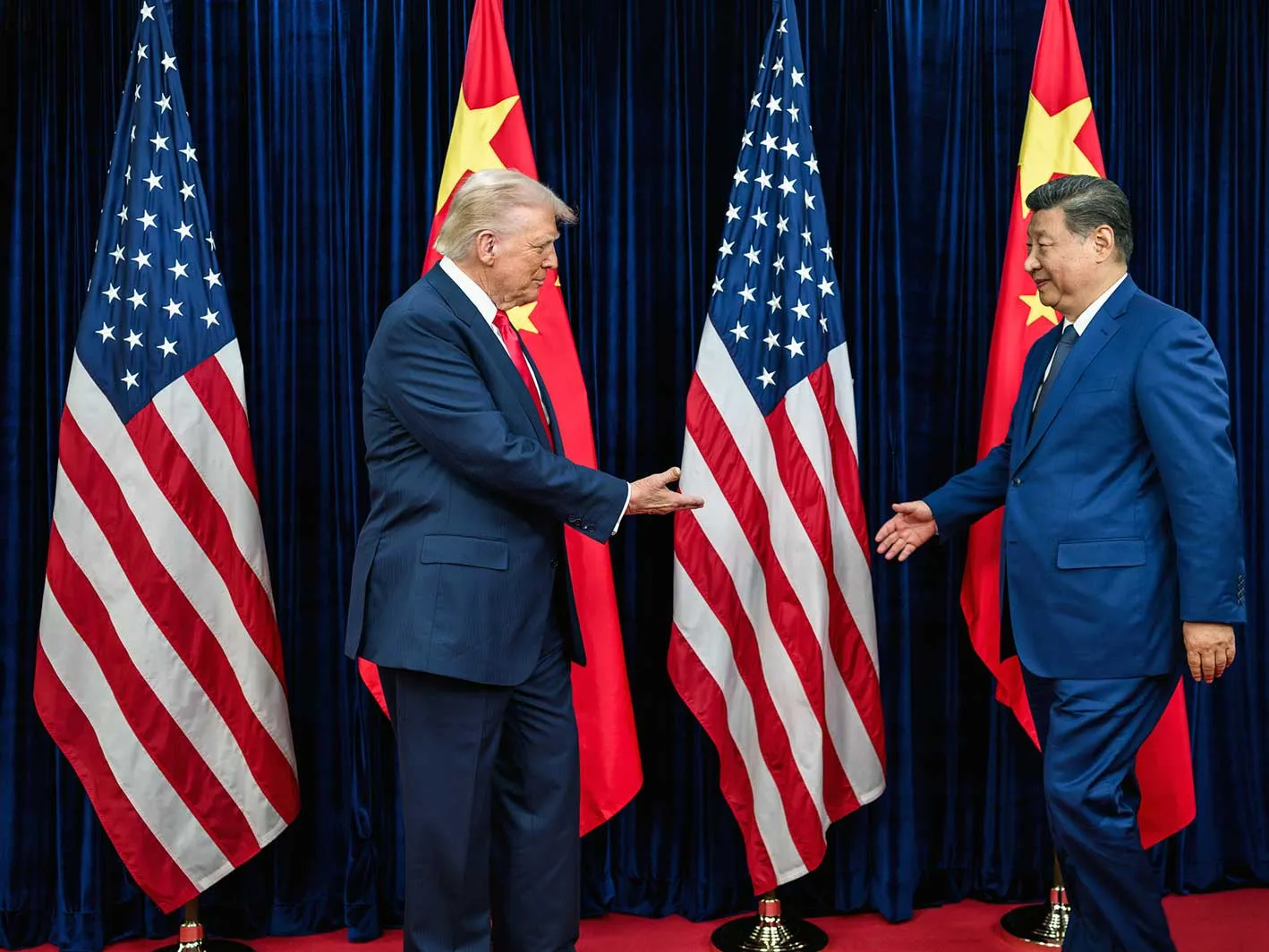
President of the United States Donald Trump greets General Secretary of the Chinese Communist Party Xi Jinping before a bilateral meeting at the Gimhae International Airport terminal in Busan, South Korea, on Oct. 30, 2025. (Official White House photo by Daniel Torok/Wikimedia Commons)
WEAI faculty member Thomas J. Christensen, James T. Shotwell Professor of International Relations and director of Columbia's China and the World Program, offers up-to-the-minute analysis of US-China relations in two high-profile outlets this month.
"What Does Zhang Youxia’s Arrest Mean?" is Professor Christensen's contribution to a white paper on President Xi Jinping's military purges jointly published by the Brookings Institution and the Center for Strategic & International Studies (CSIS), where Professor Christensen is the Pritzker Chair in the Geopolitics and Foreign Policy Department.
Professor Christensen calls the recent ouster of General Zhang, China's highest-ranking military official, "the capstone arrest of the greatest series of purges in the history of China’s PLA." He then goes on to discuss the implications of General Zhang's downfall for US policy toward China, specifically in any potential contest over Taiwan.
Professor Christensen's second piece of commentary is "Will China Overplay Its Hand?", an article for Foreign Affairs in which he assesses various scenarios for US President Donald Trump's highly anticipated summit with Chinese President Xi Jinping later this month. Subtitled "How Beijing’s Confidence Could Shake Up the Trump-Xi Summit," the article critiques the view that Washington's most recent concessions signal a decisive change in the two countries' relative status.
"That U.S. efforts to coerce China in early 2025 were poorly conceived and therefore failed to produce many positive results does not mean that China can match the United States in comprehensive national power," Professor Christensen writes. "Any Chinese perception to the contrary could lead Beijing to adopt assertive and potentially destabilizing policies in Asia."
Read the CSIS article
Read the Foreign Affairs article