
Bilahari Kausikan: ‘Agency Is Always There’
Singapore’s veteran diplomat offers an origin story for ASEAN’s more imperfect union.
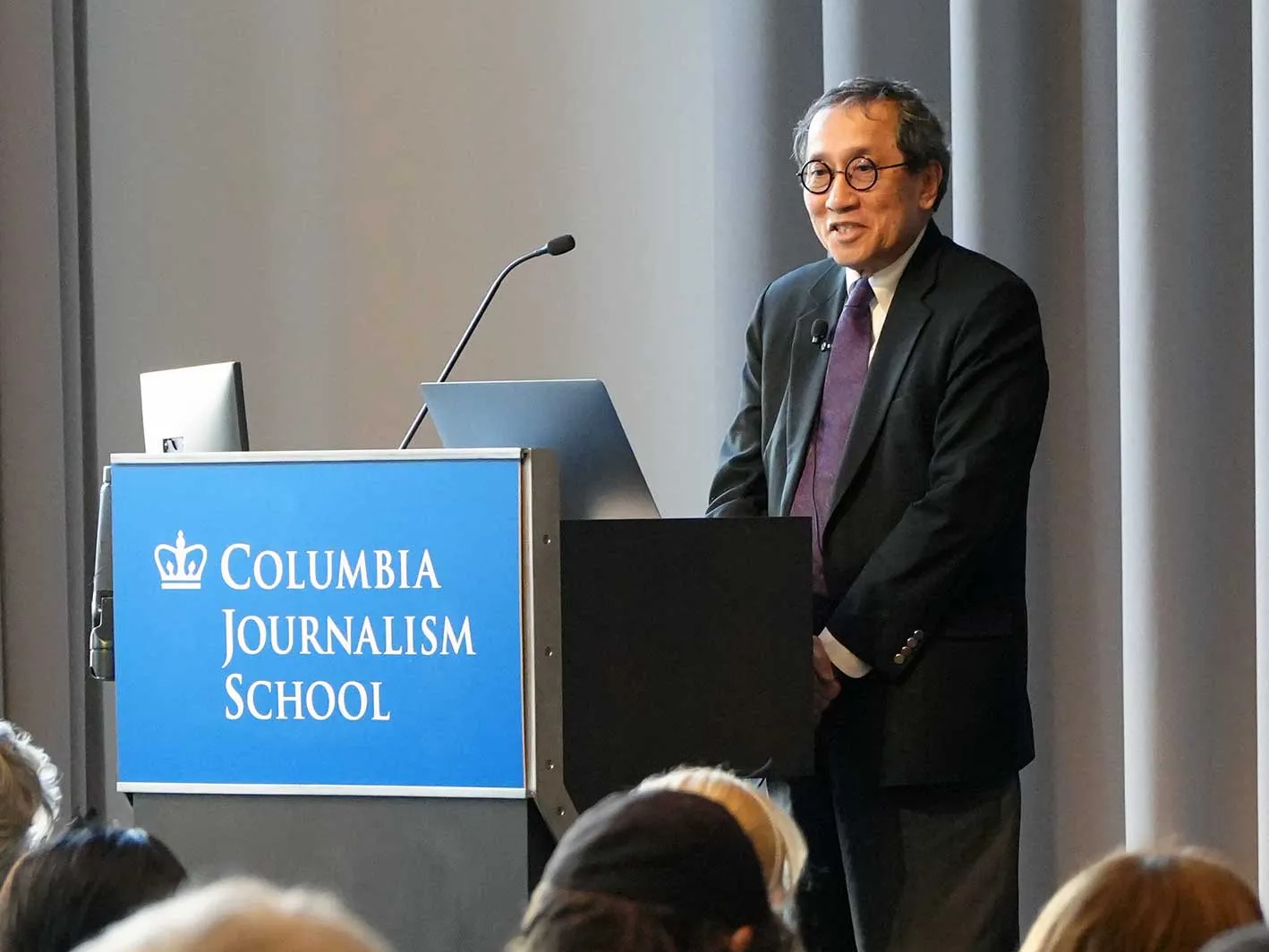
The 2025 Borton-Mosely Lecture
Co-sponsored by the Weatherhead East Asian Institute and the Harriman Institute
In an entertainingly personal yet historically informed lecture at the Journalism School on April 8, veteran Singaporean diplomat Bilahari Kausikan recounted how the Cold War and the rivalry between China and the U.S.S.R. gave rise to ASEAN (the Association of Southeast Asian Nations), the federation of states that was founded in 1967 to promote regional stability — and how the formation of ASEAN, in turn, helped shape the idea of Southeast Asia as a cohesive region with its own identity.
Delivered as the 2025 Borton-Mosely Lecture, “The Cold War, Russia-China Relations, and the Making (and Unmaking?) of Southeast Asia” peppered shrewd geopolitical analysis with autobiographical asides, references to F. Scott Fitzgerald and Reinhold Niebuhr, and frequent doses of humor.
The lecture built on the ties Kausikan established with the Weatherhead East Asian Institute last July in Singapore, when he gave a talk to Columbia alumni and visiting faculty as part of the Institute’s 2024 summer tour of Asia.
Kausikan brought to the Borton-Mosely lecture the insights gained over a long career in Singapore’s Ministry of Foreign Affairs. He served the ministry as Deputy Secretary for Southeast Asia; Permanent Representative to the United Nations in New York; Ambassador to the Russian Federation; Second Permanent Secretary; Permanent Secretary; and subsequently Ambassador-at-Large until 2018. He then served as Chairman of the Middle East Institute, an autonomous institute of the National University of Singapore.
He opened with an anecdote from his experience as a graduate student at Columbia in the late 1970s. At what was then the Russian Institute (now the Harriman Institute), he initially proposed a dissertation on Soviet policy toward ASEAN. His first academic advisor dismissed the topic as “completely inconsequential,” a judgment Kausikan never accepted. As he remarked, “Too much analysis of Southeast Asia forgets that people live there.” Kausikan never completed the dissertation, but in this lecture he returned to his long-held conviction that understanding Southeast Asia requires acknowledging Cold War legacies and the regional agency that responded to them.
“Southeast Asia is not a natural region,” Kausikan declared, but rather a historically constructed one. “The only thing intrinsic to Southeast Asia is its great diversity.”
Colonial rule fragmented the region for centuries before World War II. Each imperial power governed its territories in isolation, discouraging regional contact, and none of them conceived of their domains as part of a coherent Southeast Asian entity. That meant regionalism in Southeast Asia had to be conceived and built from scratch in the postwar era.
“The term ‘Southeast Asia’ gained currency only after the strategic imperative of recapturing the territories under occupation by Imperial Japan arose during the Second World War.”
ASEAN and the idea of Southeast Asia it represented only emerged after many “hesitations and meanderings” in the wake of decolonization and Cold War rivalries. A host of failed attempts at regional organization came and went prior to and even after ASEAN’s founding in 1967, suggesting that aspirations for some kind of regional body uniting “the Balkans of Asia” were real, even if individual states could never quite agree on the form that body would take.
Ultimately, the enduring power of nationalism, which had earlier defeated colonial rule, was what led ASEAN’s original five member states—Indonesia, Malaysia, the Philippines, Singapore, and Thailand—to band together in pursuit of common interests. Creating a regional identity wasn’t just a political strategy; it was also a survival mechanism.
For each country, Kausikan elaborated, “Trying to define your own region through regional organization was a way of asserting agency over your own destiny rather than allowing the rivalries of external powers to shape your region and determine your future.” The result was “an idea of Southeast Asia characterized by embracing the reality of diverse, even competing nationalisms rather than struggling to overcome them.”
Growing pains were real, Kausikan continued, and for at least a decade the organization’s survival was an open question. ASEAN was always going to be a somewhat fractious extended family, in part because of the diversity he noted earlier — which goes deeper than factors like each country’s level of economic development or its political system. “The key diversities are primordial differences of race, of language and of religion, and these define core identities.”
“The identities themselves, and hence the potential for conflict, will never disappear,” Kausikan said. “They lurk not very far beneath the surface of diplomatic politesse and need constant management — and this prescribes what was and remains ASEAN's primary function: the management of relationships among its members.” That challenge only increased with the later accession of new members like Cambodia, Myanmar, Laos, and Vietnam.
Kausikan argued that two broad lessons can be derived from the formative early phase in ASEAN’s history. First, it took two strong external stimuli—the Cold War and the Sino-Soviet rivalry, exemplified by such events as China’s invasion of northern Vietnam in 1979—for ASEAN’s member states to commit to regional cooperation in a sustained, meaningful fashion.
Second, ASEAN countries never approach foreign policy bilaterally. “When we say, as we perhaps do too often, that we do not want to choose in the context of U.S.–China rivalry, what we really mean is that we do not conceive of our choices in a binary way.”
In Kausikan’s telling, this multipolar worldview is a natural byproduct of historical and geographical circumstances. As a strategic crossroads between two oceans, over which larger powers continually jockeyed for influence, Southeast Asia learned to develop an “omnidirectional” statecraft — “always polygamous, never monogamous,” he added mischievously. According to him, it is this mindset that explains why today ASEAN member countries can conduct sophisticated military exercises with the U.S. and its allies while simultaneously signing agreements with China and importing arms from Russia.
Kausikan continued: “To paraphrase the great American novelist F. Scott Fitzgerald, who in this respect is a better guide to Southeast Asian statecraft than many a political scientist or historian, we have no difficulty functioning while holding two or more contradictory ideas in our heads.”
Returning to one of his fundamental concepts, Kausikan reiterated that defining the region through regional organization is a way to assert local or national agency in the face of superpower pressures. “Agency is always there,” he said. Later he added that even for a small country like Singapore, “You are never entirely without agency.”
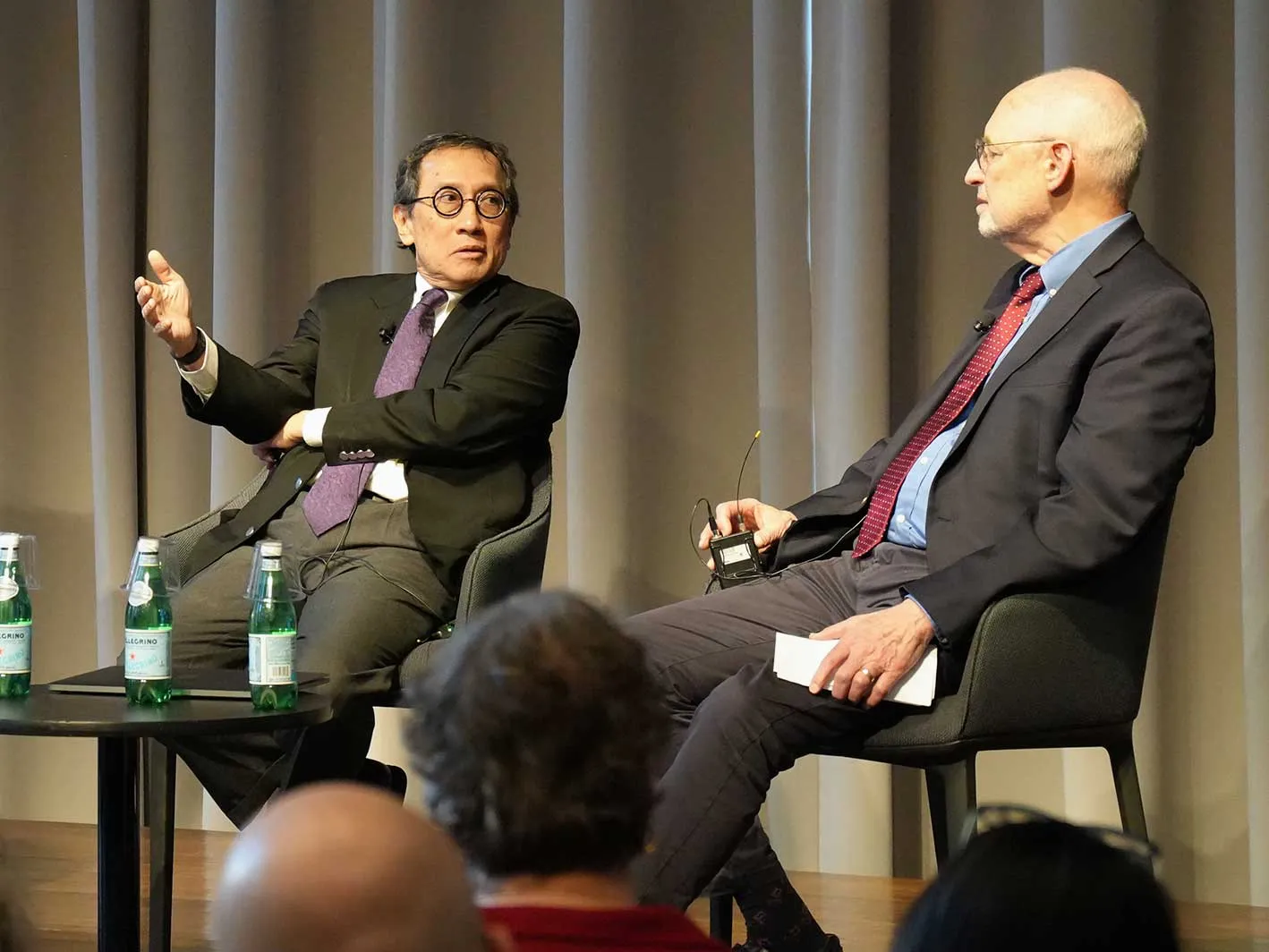
Kausikan sounded a note of Realpolitik when he turned to ASEAN’s status in the twenty-first century. Successful foreign policy, he said, depends on “the ability to make clinical, indeed, cold-blooded and ruthless assessments of interests" — an ability that in his view is increasingly being compromised by several ASEAN member states’ need to appease various domestic constituencies as they hew to more democratic (or what he called “pluralistic”) norms.
Domestic considerations, he claimed, governed ASEAN’s response to the February 2021 military coup in Myanmar. The federation’s leaders laid out a five-point consensus of the steps they expected Myanmar’s military to take to return the country to normalcy; Kausikan called those steps “totally unrealistic” and added that the five points were “aspirational and performative — a posture rather than a policy,” which only ended up making ASEAN look ineffectual.
Worse still, Thailand subsequently undermined the coalition’s solidarity by engaging in separate talks with the Myanmar junta — a development that was foreseeable given Thailand’s long border with Myanmar and the presence of so many refugees and illegal immigrants driven across its frontiers by the 2021 coup and ensuing rebellion. Kausikan intimated that Thailand’s go-it-alone outreach to the junta might even herald an eventual wider split between ASEAN’s landlocked states and its coastal ones.
He concluded bluntly: “The risk arising from ASEAN's mishandling of the Myanmar issue underscores the dangers of soft-headed or sentimental thinking and confusing feeling good for actually doing good.”
Yet the veteran diplomat ended on a hopeful note. For all its flaws, ASEAN “has proven to be a not ineffective tool for managing intra-ASEAN, intra-southeast Asian problems, and blunting the sharpest edges of intra-regional differences, even if it cannot erase them.”
As for Southeast Asia, it remains “resilient and adaptable,” he said, “at peace with itself and the world.” What began as a personal academic interest, once dismissed as unworthy of serious study, now stands at the center of how we understand one of the most dynamic and strategically vital regions in the world.
Kausikan concluded with a smile: “I only hope that having listened to me, you do not conclude that inviting me to deliver the 2025 Borton-Mosely Lecture was an act of reckless folly.”
Watch the complete video: