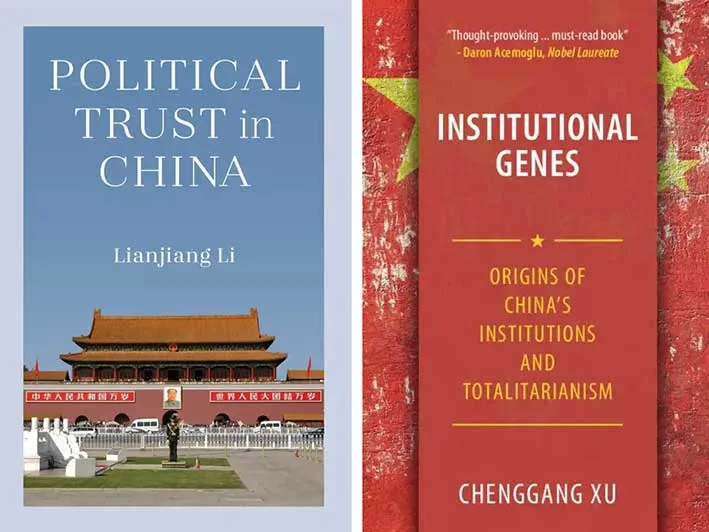
In the March/April 2026 issue of Foreign Affairs, Weatherhead East Asian Institute faculty member Andrew J. Nathan reviews two new books that challenge prevailing wisdom around the present-day Chinese Communist Party.
Nathan is the Class of 1919 Professor of Political Science in Columbia’s Department of Political Science. In “China’s Fragile Future,” he considers Political Trust in China by Lianjiang Li (University of Michigan Press, 2025) and Institutional Genes: Origins of China’s Institutions and Totalitarianism by Chenggang Xu (Cambridge University Press, 2025). He finds that both authors question widespread assumptions among China-watchers about the CCP’s stability and supremacy.
“Both books offer a needed corrective to the conventional wisdom that the Chinese regime is stable,” Professor Nathan writes, “but neither is definitive.” Readers are encouraged to read the review for themselves to see why he qualifies his praise for each book, and also for his sobering conclusion:
“Although many U.S. observers and politicians might like to exploit China’s fragility to topple the CCP, the implications of these books should serve as a warning. Lacking either the trust or the institutional genes to set up a more stable alternative, a post-CCP authoritarian regime rooted more in raw power than in engineered consensus might be even harder for the West to deal with than the relatively disciplined and strategic regime China has today.”
Read “China’s Fragile Future” by Andrew J. Nathan