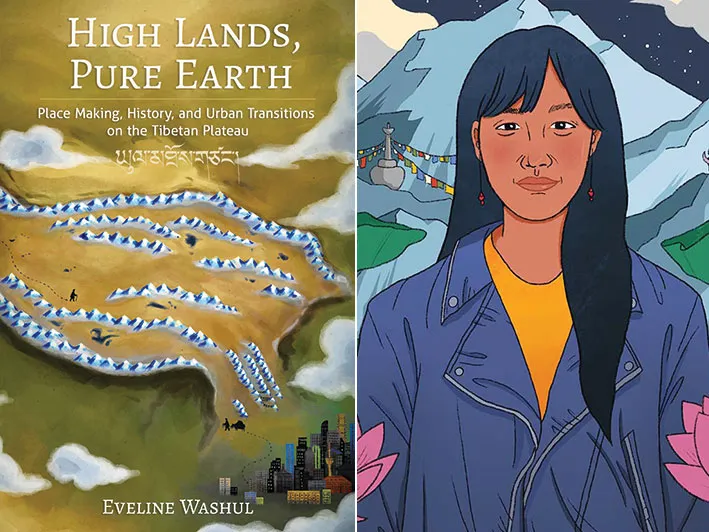
High Lands, Pure Earth: Place Making, History, and Urban Transitions on the Tibetan Plateau (Cornell University Press, 2026) by Eveline Washul (R).
Today the Weatherhead East Asian Institute is especially pleased to welcome a new title into its Studies series of monographs: High Lands, Pure Earth: Place Making, History, and Urban Transitions on the Tibetan Plateau by Eveline Washul, just published by Cornell University Press.
Eveline Washul is a sociocultural anthropologist and historian of Tibet with longstanding ties to the Weatherhead and Columbia communities. Currently Assistant Professor in the Central Eurasian Studies Department at Indiana University, she received her MA in International Affairs, East Asian Studies from Columbia and later served as Director of the Modern Tibetan Studies Program (MTSP) and Adjunct Assistant Professor in the Department of East Asian Languages and Cultures.
More recently, she has co-directed, with current MTSP Director Lauran Hartley, the Columbia University–Indiana University Climate Research Initiative on the Tibetan Plateau, a multi-year, cross-disciplinary effort to understand different types of knowledge and experiences of climate change in Tibetan and Himalayan regions through workshops, roundtable discussions, and academic exchanges. Professor Washul will also participate in MTSP’s upcoming (May 27 and 28) two-day conference devoted to climate change in the Himalayas and the Tibetan Plateau.
Professor Washul’s first book, High Lands, Pure Earth explores how Tibetans in late-reform-era China have engaged with urban transitions while maintaining strong ties to community, history, and homeland. Drawing on interviews, historical research, and Indigenous studies frameworks, Professor Washul argues that even amid pressures from Chinese state dominance and rapid economic change, Tibetans have managed to build networks of belonging and mutual care rooted in shared history, home places, and Buddhist values. She introduces the concept of tsedung—a Tibetan sense of love, empathy, and closeness—to show how emotional ties to home can extend across cities and dispersed communities, allowing urbanization to strengthen rather than erase Tibetan identity and connection.
We offer our collaborator and colleague warmest congratulations on the publication of High Lands, Pure Earth.