
New Weatherhead–Panteion Partnership Maps a Future for Area Studies
A new transatlantic academic collaboration validates regional expertise in a turbulent time.
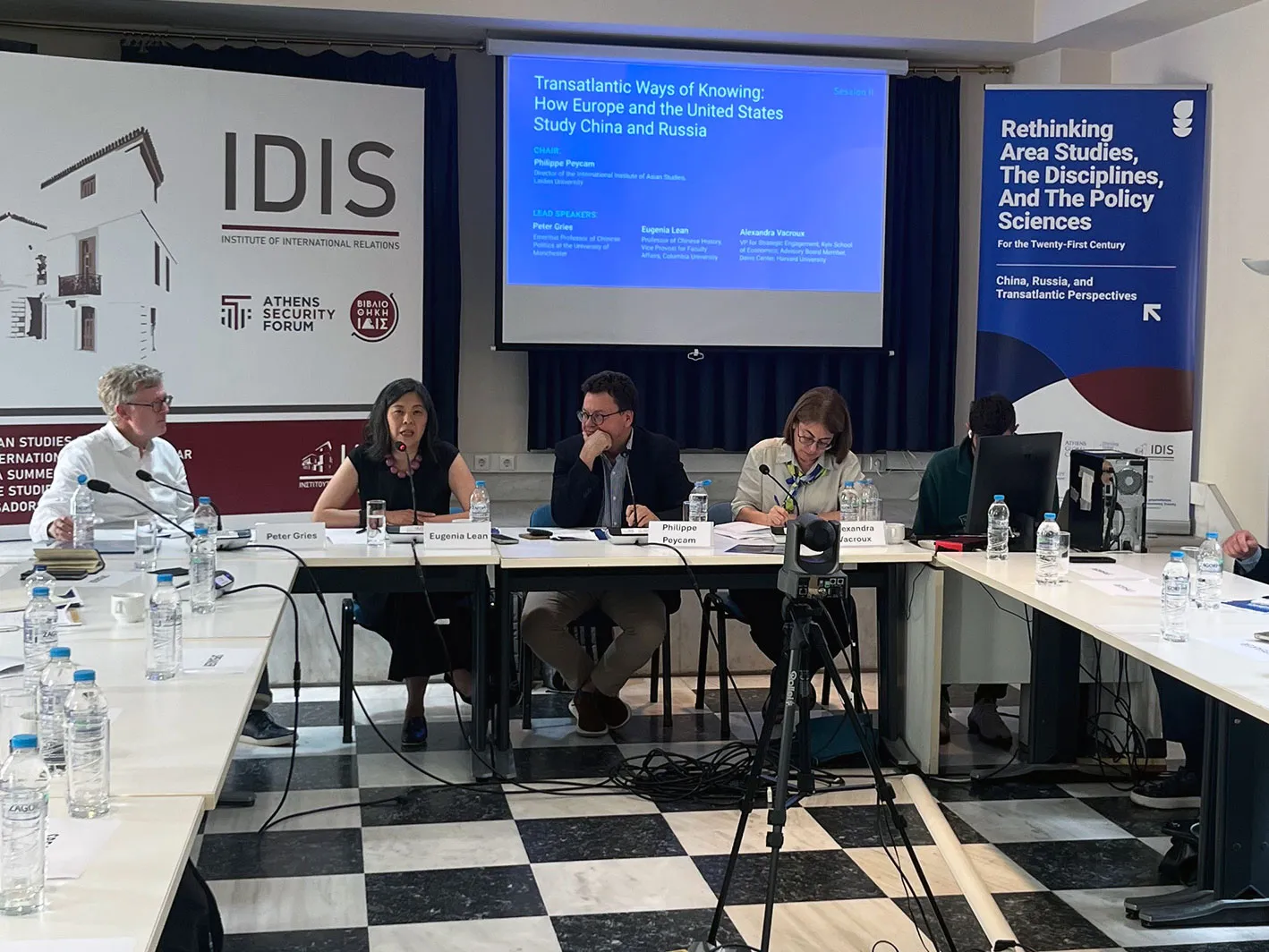
Columbia University Vice Provost for Faculty Affairs and Professor of East Asian Languages and Cultures Eugenia Lean (2nd from left) speaking at a panel discussion during the Weatherhead–Panteion conference in Athens in May 2026.
As the 2025-26 academic year winds down, the Weatherhead East Asian Institute is proud to announce its first major initiative with a European academic institution, Panteion University of Social and Political Sciences, located in Athens, Greece.
The two organizations will collaborate on a forthcoming dual master’s degree program that joins Panteion’s MSc in Global China with Weatherhead’s MA in Regional Studies: East Asia (MARSEA). Scheduled to launch in the fall of 2027 at Panteion, and then in 2028 at Columbia, the dual program will enable graduate students to attend both programs and receive degrees from both Panteion and Columbia Universities.
Weatherhead and Panteion initiated the partnership through a memorandum of understanding signed in 2024 and finalized via extensive follow-up negotiations. The agreement covers the new dual degree and opens the door to other mutually beneficial activities such as promoting cross-departmental faculty and student research on China’s foreign policy in Greece and the Balkans; co-sponsoring panel discussions; hosting visiting scholars; and co-organizing academic symposia.
What brought the two institutions together is a convergence of intellectual interests. The collaboration allows faculty to study the complex responses to Chinese influence in different countries, and it dislodges an American-centric understanding of China's role in the world (where the US tends to see China as a rival) in order to better understand how China looks to policy makers and publics in countries that are themselves not major powers — but where China is a rising power.
The relationship kicked off publicly with a two-day conference in Athens on May 22–23. “Rethinking Area Studies, the Disciplines, and the Policy Sciences for the Twenty-First Century: China, Russia, and Transatlantic Perspectives, 2026” brought together scholars and policy experts from Columbia, Panteion, and around the world to examine how the United States and Europe are responding to the challenges China and Russia pose to the international order at a time of rising geopolitical tension and economic uncertainty.
Weatherhead Director for Partnerships and Outreach Sarah Jessup led a delegation that included faculty members Thomas J. Christensen, Eugenia Lean, Xiaobo Lü, and Andrew J. Nathan. Also representing Columbia were Alexander Cooley, Claire Tow Professor of Political Science at Barnard College and a former director of the Harriman Institute; Jack Snyder, Robert and Renée Belfer Professor of International Relations; Zoe Zongyuan Liu, Senior Research Scholar at the Institute of Global Politics, School of International and Public Affairs and Adjunct Professor of International and Public Affairs; Stathis Gourgouris, Professor of Classics, English, and Comparative Literature, and Director of the Program of Hellenic Studies within the Department of Classics; and Stefanos Gandolfo, Director, Athens Columbia Global Center.
Conference participants explored whether traditional “area studies” programs still provide the kind of regional expertise that’s necessary to understand a world in which old certainties—alliances, trade agreements, and the like—have become increasingly tenuous, if they still exist at all.
In his opening remarks, Panteion Professor of International Relations Andreas Gofas decried what he saw as a longstanding devaluation of area studies in the academy. “We have spent years, in both our institutions, worrying about the retreat of area expertise. We have watched the metrics crowd it out, watched the funding dry up, watched the policy world learn to do without it.”
Panteion’s new dual degree with Weatherhead, he continued, is meant to affirm the relevance and worth of regional studies. “We know that rigorous, contextual, historically-grounded scholarship — the kind that can hold a place’s complexity without flattening it into a variable — produces better understanding than the alternatives.”
Konstantinos Tsimonis, Assistant Professor of Chinese Politics at Panteion, discussed the rationale behind the new joint program in greater detail. Rather than emulating the Chinese Studies programs of bigger, better-known Western universities, he explained, Panteion’s Global China program leans into its origins in a southern European state sometimes regarded as marginal to world affairs.
“Area studies should not be understood as passive knowledge consumption. It can also become knowledge production from the periphery.”
Equally important, he said, are mandatory language training and a realistic understanding of the professional environment that awaits the program’s graduates.
“A successful program . . . needs intellectual seriousness, methodological rigor, linguistic training, and real-world relevance at the same time,” Professor Tsimonis concluded. “But I would argue that this is precisely the future of area studies, or as we call it ‘New Areas Studies,’ ‘Global Area Studies,’ but above all relevant area studies.”
Download the conference agenda (PDF)
Watch this space in the months ahead for more information about the Weatherhead–Panteion dual degree program.