
Ronald M. Schramm’s New ‘Handbook’ Shows Where Chinese Economy Has Been — and Where It Could Still Go
China is still capable of great things, says the SIPA Adjunct Professor, but it needs a new vision of its workers “not as tools for prosperity but as beneficiaries of prosperity.”
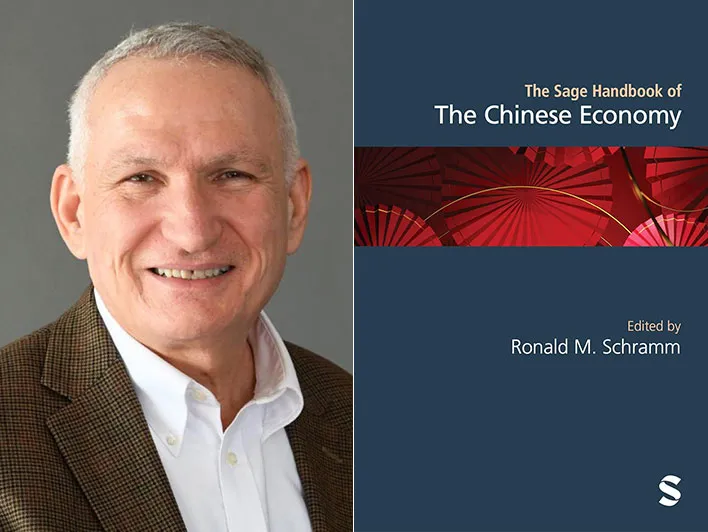
SIPA Adjunct Professor of International and Public Affairs Ronald M. Schramm, editor of The Sage Handbook of the Chinese Economy (2026).
Published this month, The Sage Handbook of the Chinese Economy is an authoritative new resource whose comprehensiveness is matched by its sense of nuance and attention to detail. In 28 chapters spread over five sections, 42 experts scrutinize virtually every aspect of the PRC’s present-day economy, homing in on such critical areas as housing, technological innovation, financial markets, and, not least of all, its workforce. The book’s concluding section examines China’s relations with the rest of the world, in such contexts as foreign direct investment and the Belt and Road Initiative, its controversial overseas development program.
The new Sage Handbook arrives at a critical juncture. Nearly five decades after the launch of the reforms that ultimately transformed it into the world’s second largest economy (measured by GDP), China is faced with intractable structural problems that — in the view of some outside observers — will make it impossible to sustain the same rate and quality of development of the past 50-odd years. Adopting what the Handbook’s editor calls a “look under the hood” approach, its contributors assess key sectors with an eye toward how they might be reconceived to help surmount China’s bigger-picture challenges.
That editor is Ronald M. Schramm, a veteran China researcher who is Adjunct Professor of International and Public Affairs at Columbia’s School of International and Public Affairs (SIPA). In addition to having taught at five Chinese universities, Professor Schramm has been a Fulbright Scholar in Beijing as well as an economist at the International Monetary Fund and a consultant at the World Bank; in 2020 he published the second edition of his textbook China Macro Finance: A U.S. Perspective. Via email, he answered our questions about the Handbook.
The Sage Handbook of the Chinese Economy arrives in the same month that the CCP officially launches the 15th Five-Year Plan—the planning document that maps out its economic priorities from now through the year 2030. Do the goals announced in this five-year plan align with the prescriptions or analysis in the Sage Handbook in any meaningful way?
One of our chapters, by Nathan Dong and Ziyang Wang, discusses Chinese government planning in general and Five-Year Plans specifically. We note that since 1953 most of China’s Five-Year Plans have focused on supply (or production) in the economy (in contrast to the United States, where demand-side economics is front and center). For example, earlier plans had “agriculture” production as the most commonly mentioned word. (By the way, the handbook has an excellent chapter by Jikun Huang of Beijing University on China’s agricultural sector — its challenges, opportunities, and outlook.) But since around 2011, Five-Year plans have gradually shifted in emphasis toward demand considerations. A multitude of chapters deal with this new emphasis on demand, including Sherry Yu’s chapter on savings and consumption.
Broadly speaking, a major theme in the new 15th plan is the ongoing goal of moving from quantity of growth (production goals) to quality of growth — higher value-added production and higher returns on capital. While both the plan and the Handbook cover this from a variety of angles, the mesh is not perfect. The plan views quality of growth from the perspective of new technologies (think quantum computing and advanced semiconductors); the Handbook authors address this approach especially in the specific industry chapters (see the semiconductor discussion below) but also take a broader perspective on this quality-of-growth question. Authors examine the need for institutional reform (think property rights, legal reform, and human capital development) as central to the goal of quality of economic growth. China’s plan, in contrast, emphasizes greater centralization, discipline in governance, and reform (not dismantling) of state-owned enterprises.
Another major theme in the most recent plan continues with the “dual circulation” concept of greater self-reliance from both internal demand and supply. Specifically, enhancing consumption demand and modernizing industry while at the same time becoming even more strategic when it comes to the “fickle” external sources of demand and supply. Many handbook chapters address the topic of dual circulation either explicitly (Sherry Yu’s, mentioned above) or implicitly (Irina Fan’s excellent chapter on China’s digital economy).
But enhancing consumer demand requires enhancing consumer incomes — a challenge that is well addressed in four separate chapters in the “Human Capital” section of the handbook. Over the years, the Five-Year plans have also come to have a greater focus on the role of China’s greatest resource — its people; and the most recent one sets goals for expanding China’s broad but very thin social safety net.
Finally, the most recent plan looks outward in terms of strategic investments and RMB internationalization – given the internal economic challenges China is facing, these are firmly committed albeit longer-term goals. We see the final section of the handbook addressing China’s foreign direct investment, RMB internationalization, China’s balance of payments, and the Belt and Road initiative. These are all excellent chapters that consider what China has accomplished so far and what is possible in the future.

An engineer inspects a chip in a Hangzhou semiconductor laboratory in 2022. (sinology/Getty Images)
Your SIPA colleague Julian Gewirtz recently published an informative New York Review of Books article that touches on the CCP’s growing control over China’s native computer chip industry. That makes us curious to hear more about the conclusions Tariq H. Malik reaches in his Handbook chapter, “Institutional Sclerosis of the Chinese Semiconductor Industry.” Is Malik as skeptical about the likelihood of China catching up to the US (and Taiwan) in semiconductor manufacturing as his title suggests?
Thank you for asking this question, as it highlights a key goal I had in putting this handbook together: I wanted to take a deep dive into certain sectors and industries of the Chinese economy. There has been so much written at the macro level — I wanted to go beneath that surface and explore a bit.
Professor Malik examines the historical trajectory of China’s semiconductor industry and asks where China has advantages, and do those current advantages create a certain “sclerosis” — an inability to respond to technological and market innovations. He identifies the manufacture of legacy chips, packaging of chips and integration into consumer products, and the processing of raw materials as inputs as areas where China has strengths. He suggests that these strengths tend to “distract” China from growing into the areas of design, high-end fabrication, high-end equipment manufacture and branding — strengths found in other countries, including the United States.
Malik goes on to argue that notwithstanding the impressive gains in basic research, Chinese industry has had difficulty translating scientific discovery into technical applications. Malik presents some interesting developments in the Chinese semiconductor industry such as regional clusters of specialization in cities like Shenzhen or Beijing. In addition, China is unique in the degree to which the state supports, through subsidies and access to credit, the semiconductor industry.
The takeaway from Malik’s chapter is that China’s semiconductor industry is inevitably shaped by China’s industrial policies and success as a manufacturer of downstream electronic equipment and consumer products. This, to a certain degree, locks in the profile of the upstream semiconductor industry. For example, government subsidies will bias the industry to meet the needs of the government (think Five-Year Plans). In contrast, a vibrant venture capital space might force the industry to meet ever-changing market needs. The question then becomes not so much a question of global supremacy, but which segments of the industry the Chinese will excel at and whether or not they can move up the value chain given the unique context in which the industry operates.
“What really motivates me to teach and research about China is the wonderful character of the Chinese people — their rich and turbulent history and their complex economic circumstances.”

Construction in Shanghai, China, in July, 2025. (lowangle/Unsplash)
These days a certain strain of China-watching, mostly online, lauds the country’s achievements in infrastructure and technology but seldom acknowledges pervasive inequality. Do the two chapters focused on economic disparities in Part 3 of the handbook, “Human Capital,” offer any hope for narrowing the gap between rich and poor?
These chapters acknowledge that without inclusive growth, China’s long-term growth prospects are under threat. If a key ingredient in the production process, labor, is not adequately incentivized, it becomes more and more of a challenge to achieve long-term economic growth. The most recent Five-Year plan recognizes the problem and proposes some remedies. Hedda Flato and Kristen Dalen, in their excellent chapter, ask how so much prosperity can be created while such severe inequality festers. Fang, Hartley, and Khan answer this question, in part, by discussing the failure of labor unions to adequately represent the interest of workers. Of course, China is not unique in terms of growing income and wealth inequality.
The chapters by Jiwei Qian and Flato and Dalen present the enormous challenges China faces in terms of wealth and income inequality. But both sets of authors also point out the tremendous success China has had in lifting hundreds of millions of its citizens out of abject poverty via economic growth. Qian provides a nice historical account of the development of the social safety net (pensions, health insurance, and unemployment benefits), which has steadily expanded since the early 2000s. But as mentioned above, while the majority of the population has some form of social safety net coverage, the benefits are generally quite small (with the exception of government retirees).
Qian lists the challenges of creating greater equality via the social safety net. These include great regional income differentials (coastal and southeast provinces versus inland provinces). But even within prosperous coastal cities there is a great dispersion of income and wealth. These differences are tied into structural issues embedded in the rural/urban divide in terms of social safety net access. And this is linked to another structural issue — the large number of informal and self-employed workers (typically from rural areas) who do not participate in safety net programs. This, in turn, is linked to China’s unique hukou (local residency card) system, which disadvantages rural migrants in a variety of ways. Compounding these challenges, it is local governments that are responsible for much of safety net expenditures and these governments are already lacking finances. These are enormous structural challenges to the goal of “common prosperity” which President Xi hopes to achieve.
The authors suggest that China has achieved, and still can be capable of, great things; just as abject poverty has been eliminated in China, so too can income and wealth inequality be reduced. What is required is political will — a new vision of the labor force not as tools for prosperity but as beneficiaries of prosperity. Flato and Dalen suggest redistribution via the tax system, institutionalizing equality via Five-Year plan incentives and mandates to cadres, reform of the hukou system. Fang et al suggest greater bargaining power via labor unions. If I were to add to this list of reforms, I would include the removal of state ownership from nonessential areas and finding a way to assign that ownership to citizens (it is estimated that as much as 40 percent of productive assets in China are held by the state). None of this is easy, but as I said, “China is capable of great things.”

The Standard Gauge Railway station in Nairobi, Kenya, in September 2024. (Ravi Dwivedi via Wikimedia Commons)
The last chapter in the Sage Handbook is your investigation into the Standard Gauge Rail line China funded in Kenya as part of its Belt and Road Initiative (BRI). One noteworthy aspect of your article is its even-handedness: the phrase “debt-trap diplomacy” doesn’t once appear in it, for instance. Tell us about how you decided to frame your research into the Kenya railway project.
So much has been written about the downside risks of China’s BRI; I wanted to look at the actual finances of a specific project and see what we could learn about the broader initiative. Specifically, I thought applying the tool of real options would uncover in a technical way the opportunities that China was creating by building the Standard Gauge Rail line in Kenya — connectivity to at least five other surrounding countries with natural resources. Well, I found that not only was the project losing money in Kenya, but the optional value of the project was also quite small.
In the process of doing the research, however, I was led in a different direction toward economic spillovers — that is, economic “externalities” beyond the project itself. There is a fantastic literature on the economic spillovers of railroads ranging from Robert Fogel on the United States to, more recently, MIT professor David Donaldson on India. They show that spillovers from rail projects can have a substantial long-term impact on GDP levels and economic growth.
That sort of “turned things on its head” with regard to the Kenya rail line by raising a host of institutional questions. Is China seeking supra-spillovers in trade between continents and if so, who would be the beneficiaries of these spillovers, the elites or the citizens of China, Kenya, and beyond? Are these spillovers sufficient to make the Kenyan project financially viable? How can the internal fiscal pressures from the Kenyan rail line be resolved institutionally?
Your profile page on the SIPA website mentions that you’ve been studying China’s economy and Chinese business since the early 1990s. What motivates you to keep active in this particular field? Did you approach the Sage Handbook (which comes in at a formidable 656 pages) as the culmination of all those years of engagement with China?
I’ll first note that the 656 pages were in a pretty small font — my authors had a lot to say! What really motivates me to teach and research about China is the wonderful character of the Chinese people — their rich and turbulent history and their complex economic circumstances.
Secondly, the students in my Chinese economy class at SIPA motivate me. Most of them are from China and they “keep me on my toes.” I need to walk into the classroom with the knowledge that at least one student in the classroom may have a more intimate understanding of the topic of the day than I do. I’d hate to lose face….